
Tour review · BUDAPEST WALKING TOURS
Budapest Art Nouveau Walking Tour
Budapest wears Art Nouveau like evening jewelry. In this 3-hour walk, I love two big moments: getting inside the Palace of the Royal Post entrance hall and spending time with the details at Gresham Palace. That mix of street spectacle plus interior peeks makes the style easier to understand, not just admire.
I also like how the tour trains your eye for the Hungarian take on Art Nouveau, especially Zsolnay porcelain and the Asian motifs designers used. One consideration: access can change by day. On weekends, you cannot enter the Hungarian National Bank, and the orthodox Kazinczy Street Synagogue is closed on Saturdays, so the final stop may depend on your day.
This is led by an English-speaking historian guide, and I’m glad it is a small, focused format. If you want a quick, high-impact way to grasp the “why” behind the ornament, this tour is a strong choice.
Key highlights you will actually notice on the walk
- Entrance-hall time at two of the most important buildings, so you see exterior details and interior design logic
- Ödön Lechner’s flamboyant approach, often compared to Hungary’s Gaudi, at the Palace of the Royal Post
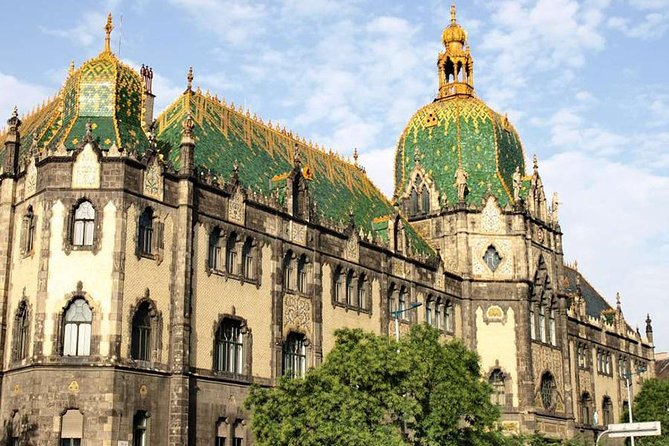
- Zsolnay ceramics from Pécs, plus porcelain tile examples like you might spot at Thonet House
- Asian motifs and European Orientalism explained in a way that helps you read the building surfaces
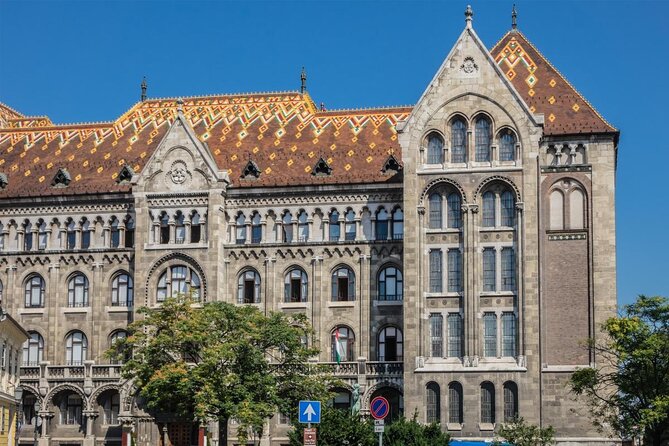
- A finishing moment at the Kazinczy Street Synagogue, known for its Art Nouveau interior work
Budapest on foot, with a few more routes to compare
- Big Bus Budapest Hop-On Hop-Off Bus and Walking Tour★ 3.5 · 2,206 reviews
- Budapest: Buda Castle District Walking Tour★ 4.6 · 2,108 reviews
- Budapest City Landmarks Walking Tour in 2 Hours★ 5.0 · 2,048 reviews
- 3-Hour Orientation Walking Tour of Buda and Pest★ 4.8 · 1,834 reviews
A 3-hour Art Nouveau walk that fits real Budapest timing
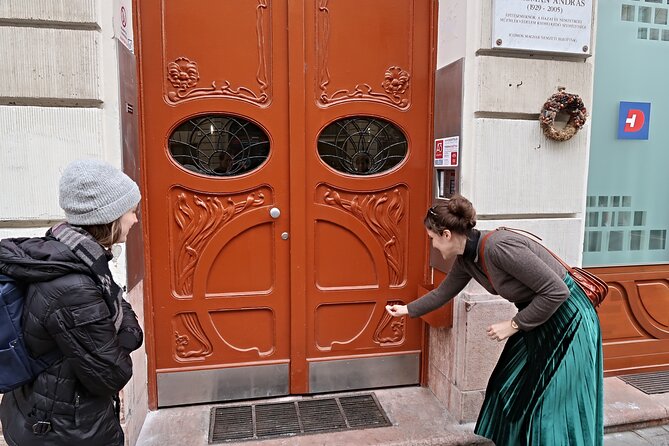
This tour runs about 3 hours, which is a gift in Budapest, where you can easily lose half a day to transit and wandering. You get enough time to see multiple Art Nouveau stops, then actually process what you saw, without rushing through every facade like it is a checklist.
The walk also works well because the tour is designed around architecture you can pause at. Some stops are exterior focused, but the tour goes further when it can. You will not be stuck staring at a building from across the street the whole time. Two major sites allow you into the entrance halls, which helps you understand how Art Nouveau design carries from the outside into daily use.
The tour is English, and it is offered as private or small groups, which usually means questions get answered instead of getting swallowed by crowd noise. Tram and metro tickets are not included, so plan to use walking plus transit if you are starting farther away.
Starting point at Madal Café, then Bedö House and the street-level training
If you choose the optional pickup, you meet at Madal Café, Budapest, Alkotmány u. 4. If you select another option, your meeting point may differ, but the key idea stays the same: you start in central Budapest and begin with buildings that teach you how to see Art Nouveau correctly.
The first guided stops include Bedö House, then you continue along streets and passages such as Rózsavölgyi utca and Paris passage. These quieter spaces matter because Art Nouveau in Budapest is not only about the obvious showpieces. It also lives in the way designers treated thresholds, storefront interiors, and passageways where people would slow down and look.
Here is the practical part: once your guide points out what to look for, you start noticing patterns fast. You learn to connect ornament to the overall design attitude, not just collect pretty details. That matters later, when you see porcelain tiles and Asian-inspired decorations. Without the early “how to read” lesson, you might admire the surface but miss the meaning.
The Palace of the Royal Post by Ödön Lechner: where “Hungary’s Gaudi” clicks
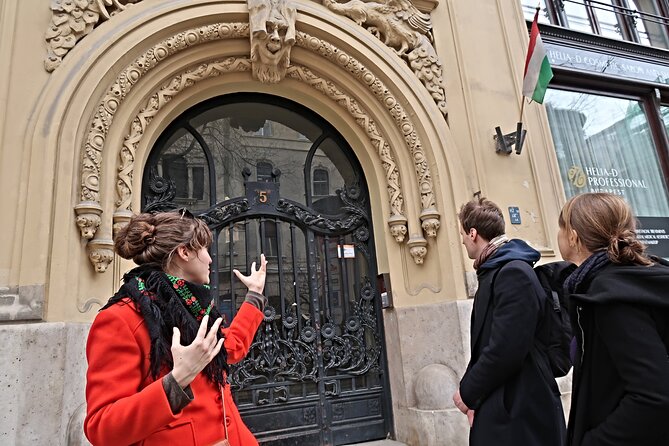
One of the tour’s anchor stops is the Palace of the Royal Post, tied to Ödön Lechner. It is known as Hungary’s Gaudi for a reason: the building has that energetic, almost theatrical design language that makes Art Nouveau feel like it is moving.
What makes this stop especially valuable is that it offers entry to the entrance hall. You can look at the details outside, then step in and see how the design continues inside. Art Nouveau often feels more convincing when you see the full design concept in one place, and entrance halls are ideal. They are functional spaces, so the style is not just a postcard facade.
As you are inside, your guide helps you connect Lechner’s Hungarian Secession approach with the bigger Art Nouveau movement across Europe at the turn of the 20th century. You’ll also see how porcelain and decorative surfaces play into the overall message of prosperity and cosmopolitan confidence that Budapest was developing at that time.
Practical tip: keep your camera handy, but also pause with your head up and your eyes moving. Entrance halls reward slow looking. If you rush, you will miss the layered detail that makes Lechner’s style feel so alive.
Gresham Palace: the exterior glow and the interior logic
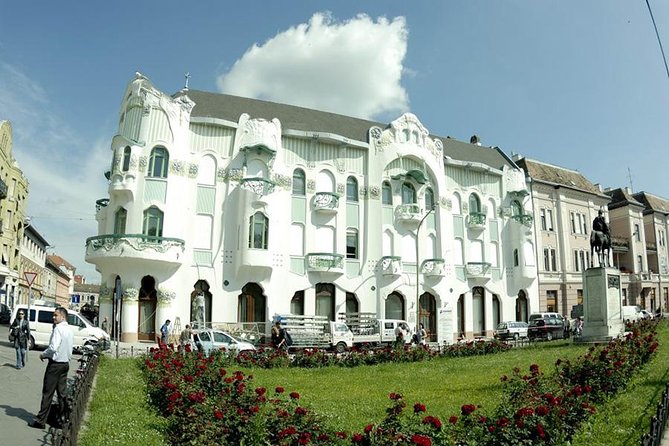
Next, you focus on Gresham Palace, one of the best places in Budapest to understand how Belle Époque glamour turned into built form. The tour emphasizes both the facade and the interior design work, and again, you get something crucial here: access to the entrance hall.
Why does this matter? Because it is easy to assume Art Nouveau is only about decoration. In reality, it is a design philosophy. When you see interior details discussed and then you look back at exterior elements, you start recognizing repeating ideas: how surfaces guide your eye, how motifs fit into architectural structure, and how “affluence” and “cosmopolitanism” show up in ornament choices.
This is also a good moment to learn how Hungarian designers adapted European trends into something distinctly local. Budapest’s Art Nouveau is not a copy-paste style. It has its own personality, and the guide helps you place that within the broader story of the movement.
You may also pass by or stop for guided looks around other commercial interiors along the way, including a flower shop with its original interior, a department store, and several bank offices. Those are not filler stops. They show you that the same design energy was used where people shopped, met, and did business.
Budapest on foot, a few more ways
- Budapest: Buda Castle Walk with Saint Stephen’s Hall
★ 4.5 · 3,012 reviews - Budapest: 3-Hour Grand City Tour and Castle Walk
★ 4.3 · 1,437 reviews - Budapest Historical Sightseeing – Free Walking Tour
★ 5.0 · 1,302 reviews - Budapest All in One Small Group Walking Tour with Strudel Stop
★ 5.0 · 1,277 reviews - Budapest: Buda Castle District Walking Tour with a Historian
★ 4.9 · 867 reviews
Zsolnay porcelain tiles and Thonet House: how ceramics steal the show
If you want proof that Hungarian Art Nouveau was about more than shape and line, pay attention to Zsolnay porcelain. The tour explains that Hungary used ceramics heavily, and it gives you examples you can recognize on facades.
One highlight for this theme is Thonet House, where you can consider the use of Zsolnay porcelain tiles in the facade. The goal is not just to see tiles. It is to learn what makes Zsolnay style recognizable in the first place, and how designers used ceramic to create texture, shine, and visual rhythm on building exteriors.
The tour also examines ceramics from the renowned Zsolnay factory in Pécs. That is a smart teaching tool because once you have handled or closely studied material examples, you can spot it more confidently when you see it built into architecture. Without that context, porcelain tiles can blur together into generic “pretty decoration.”
Here is what I think you should watch for: look for places where the facade seems to have a deliberate surface quality, not just painted ornament. Ceramics change how light hits a building, so in person you will often feel the building is more dimensional than it looks in photos.
Asian motifs in Hungarian Secession: symbolism you can actually track
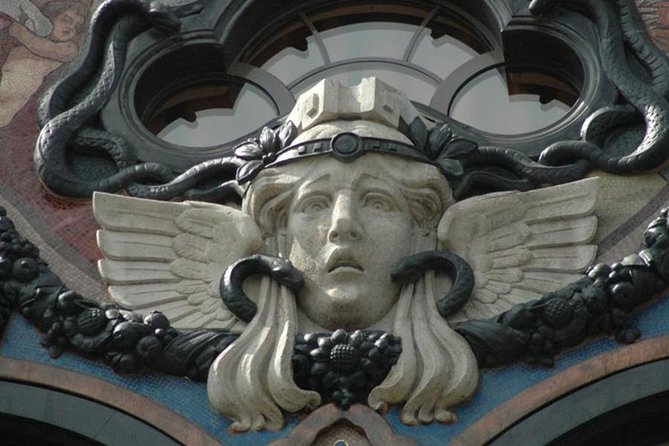
Hungarian Art Nouveau is often described with Asian motifs and elements, and the tour does more than say they are there. You also hear why: there’s the idea of supposed eastern origins of the Hungarian nation, plus the wider European fascination with the “Orient” that influenced Art Nouveau designers across the continent.
I like this part because it prevents a common mistake. It is tempting to treat motifs as decoration only, like stickers placed for effect. The guide helps you understand that these elements were part of a design conversation about identity, imagination, and modernity. Designers wanted to look cutting-edge, but they also wanted a story to hang the ornament on.
As you walk, you can apply a simple lens: ask yourself what role the motif is playing. Is it repeating like a pattern that anchors the facade? Is it framed like a centerpiece? Is it integrated into architectural forms, or does it look applied on top? Those answers help you see Hungarian Secession as a coherent system, not random exotic flair.
You also get introduced to the idea that Art Nouveau across Europe used Orientalism in different ways. That context matters because it turns Budapest’s decorations into something you can interpret, instead of something you only have to accept as mysterious.
Kazinczy Street Synagogue finish: Art Nouveau in an orthodox interior
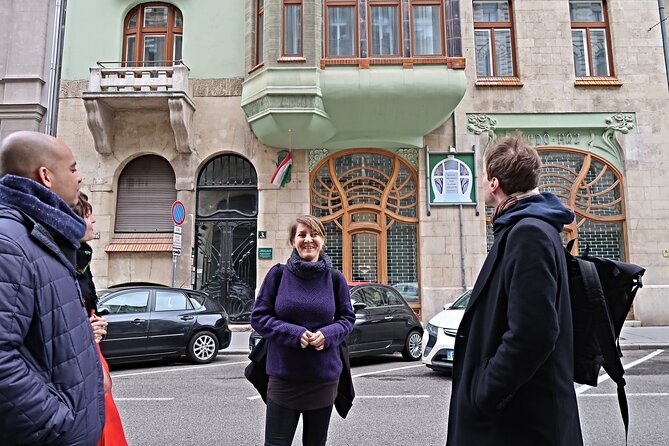
The tour concludes with the Kazinczy Street Synagogue, famous for its fascinating Art Nouveau orthodox interior. This ending works because it contrasts with the earlier commercial grandeur. You get a different kind of drama: the same design language, but applied to a sacred space.
Your experience here can change depending on the day. The synagogue is closed on Saturdays, and the tour can be adapted to your interests if the stop is not possible. The information provided also notes that additional costs may apply for entry, listed at 2000 HUF per person (about $7.00) for the orthodox synagogue on Kazinczy street.
If you are traveling on a Saturday and you still want the strongest interior focus, the tour offers alternatives that can include other Art Nouveau jewels in Budapest, such as the Gellért Bath Hotel, the Museum of Applied Arts, and the Geology Museum. On days when you cannot enter certain sites, flexibility becomes part of the value, not an inconvenience.
Also keep in mind another optional site mentioned: the House of Hungarian Art Nouveau, with an indicated cost of 1000 HUF per person (around $3.50). If your tour day allows it and you want more context, it can extend your understanding of the style beyond just facades.
Price and value: what $123 buys you in practice
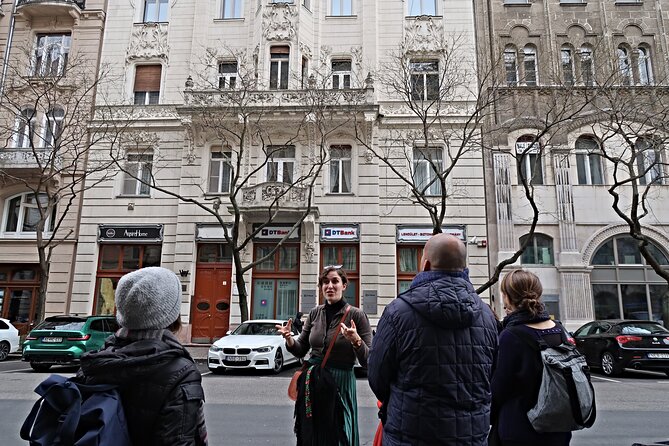
At $123 per person for a 3-hour walking tour, you are paying for three things that are hard to replicate on your own unless you plan carefully.
First, you get a historian guide. The tour is built around interpretation, not just locations. You learn how Hungarian Secession fits into Art Nouveau, why porcelain matters, and what Asian motifs are trying to communicate.
Second, you get access to interior time in key places. The tour specifically notes that two important buildings allow visitors into the entrance hall, so you can see more than flat exterior beauty.
Third, you get a structured route that ties multiple examples together: Lechner’s Postal Bank, Gresham Palace, porcelain tile examples like at Thonet House, plus the finishing moment at Kazinczy Street Synagogue when open.
What is not included is also clear. Tram and metro tickets are not included, so factor that into your day budget if you need transit between stops.
There may be additional entrance costs for optional sites, and entry availability depends on the day of week, so your best value usually comes from choosing a weekday if you want maximum access without relying on substitutions.
Who this tour suits best, and who might want a different plan
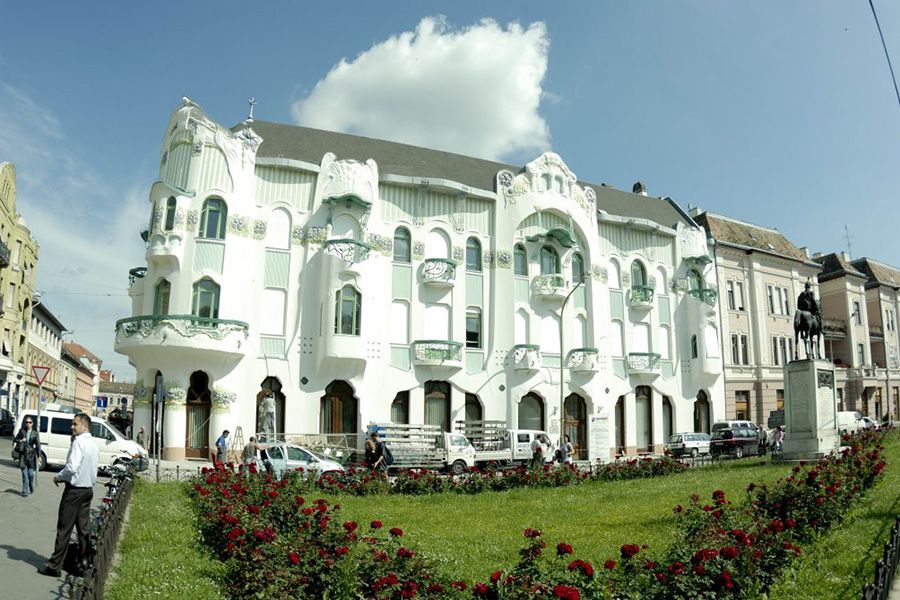
This tour is ideal if you want a high-quality snapshot of Budapest’s Art Nouveau and Hungarian Secession without spending hours researching each building. You’ll likely enjoy it most if you care about design details, ceramics, or how architecture communicates wealth and identity.
It is also a strong fit if you are a first-time visitor and want the vibe of the city’s Belle Époque energy, but in a practical way. Three hours is long enough to notice patterns, short enough to keep the rest of the day open for markets, viewpoints, or the Danube area.
If you are only interested in the absolute biggest landmarks and you hate walking, you might prefer a tour that focuses on fewer sites with more transport. But if you like to learn while you walk, this one hits the sweet spot.
One more real-world note: because entry depends on days (especially Hungarian National Bank access on weekends and synagogue access on Saturdays), your experience will be smoother if you match your visit day to the stops you care about most.
Should you book it? My straightforward take
Book this tour if you want to see Budapest’s Art Nouveau with an expert eye and you care about details you can miss on your own. The value comes from the combination of interior entrance hall time, porcelain-and-motif education, and a route that connects commercial interiors to major landmark architecture.
If you are in Budapest on a weekend, or specifically on a Saturday, plan for the tour to adapt. That doesn’t make it worse, but it does change what you can personally enter. If your priority is the Kazinczy Street Synagogue interior, aim for a weekday when it is open.
Finally, the pricing makes sense for a 3-hour guided format with a historian and meaningful stop access. For a city like Budapest, where self-guided architecture viewing can be hit or miss without context, this kind of guided structure is often the difference between pretty photos and a real understanding.
FAQ
How long is the Budapest Art Nouveau Walking Tour?
The tour lasts about 3 hours.
What is the price per person?
It is priced at $123 per person.
Is the tour guide English-speaking?
Yes, the live tour guide is English.
What is included in the tour price?
You get a 3-hour walking tour and a historian guide.
Are tram and metro tickets included?
No, tram and metro tickets are not included.
Can you enter the Hungarian National Bank and Kazinczy Street Synagogue on every day?
No. On weekends you cannot enter the Hungarian National Bank, and the Kazinczy Street Synagogue is closed on Saturdays.
Are there extra entrance fees?
Additional costs may apply. The House of Hungarian Art Nouveau is listed at 1000 HUF per person (about $3.50), and the orthodox synagogue on Kazinczy street is listed at 2000 HUF per person (about $7.00).
More Tours in Budapest





Keep Walking Budapest




More Tour Reviews in Budapest






Recently added around Budapest



Budapest Walking Tours, compared.
 ★ 3.5Big Bus Budapest Hop-On Hop-Off Bus and Walking TourFrom $422,206 reviews
 ★ 4.6Buda Castle District Walking TourFrom $142,108 reviews
 ★ 5.0Budapest City Landmarks Walking Tour in 2 HoursFrom $32,048 reviews
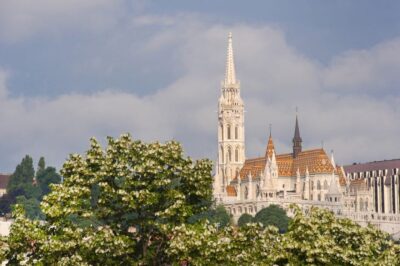 ★ 4.83-Hour Orientation Walking Tour of Buda and PestFrom $411,834 reviews
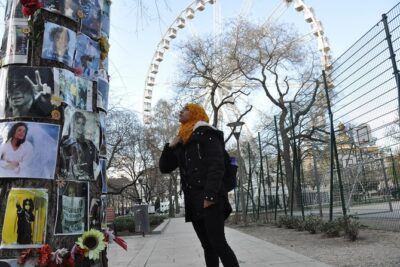 ★ 5.0Budapest Historical Sightseeing – Free Walking TourFrom $31,302 reviews
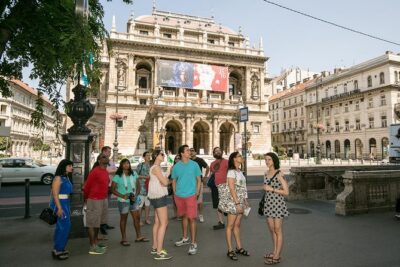 ★ 5.0Budapest All in One Small Group Walking Tour with Strudel StopFrom $1001,277 reviews
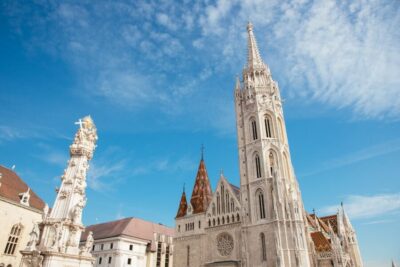 ★ 4.9Buda Castle District Walking Tour with a HistorianFrom $63867 reviews
 ★ 4.9BloodThirsty Hungary: Walking tour & Dark Historical StoriesFrom $21633 reviews
Browse the lists this tour appears in