
A phone-guided walk through Budapest’s festive past. This self-guided route uses the Rewind app, where professionally made stories and actor-led moments start automatically as you walk, so you’re free to go at your pace and start whenever it fits. You cover big-name streets and landmarks, plus the Jewish Quarter area that today blends history with lively nightlife.
I like the flexibility most. You can start on your schedule, alone or with others, and the whole thing runs about 1 hour 30 minutes. I also like that the narration is designed like a real tour experience, with professional guides and actors, not just bland audio facts.
One thing to consider: you’re relying on your phone. If your booking does not link smoothly to the Rewind app, you may lose time sorting it out, and support can feel slow. Still, once it’s working, this tour is an efficient, fun way to understand what you’re seeing, not just check off sights.
Key highlights worth planning around
- Rewind audio runs hands-free as you walk, so you can focus on streets, buildings, and small details
- Major landmarks in one tight loop, from Andrassy Avenue and the Opera area to the Great Synagogue and Szimpla Kert
- Andrássy Avenue connects old grand Paris vibes to Budapest luxury (it’s even UNESCO-listed)
- You get both sobering and playful stops, starting with the House of Terror context and ending in ruin-bar Budapest
- Short duration works in bad weather, since the route is compact and you can keep moving even if it’s raining
Budapest on foot, with a few more routes to compare
- Big Bus Budapest Hop-On Hop-Off Bus and Walking Tour★ 3.5 · 2,206 reviews
- Budapest: Buda Castle District Walking Tour★ 4.6 · 2,108 reviews
- Budapest City Landmarks Walking Tour in 2 Hours★ 5.0 · 2,048 reviews
- 3-Hour Orientation Walking Tour of Buda and Pest★ 4.8 · 1,834 reviews
How the Rewind format works, and why it feels different
This is a self-guided walking tour with no live person to follow. Your smartphone is the guide, and the Rewind app triggers the stories automatically as you reach each moment along the route. The experience is designed so you can start at any time during the day, then walk the loop in about 90 minutes.
The big advantage here is control. If you want photos, you stop. If you want to linger at a street corner, you can. If you’re traveling with friends at slightly different paces, you can still all follow the same audio without splitting into a group shuffle.
One practical note: since the app is central, make sure your phone battery is happy. Bring a charger or a fully charged power bank if you’re doing multiple things that day. You’ll also want mobile data or offline access to whatever the app requires, since you’re relying on a working connection for the audio prompts.
Price and time: great value for a first Budapest half-day
At $14.47 per person for about 1 hour 30 minutes, this is one of those “small ticket, big payoff” tours. You’re not paying for a private guide’s time for the whole morning. You’re paying for the structure and the story, plus the convenience of an app that keeps things moving.
The route is smartly paced for a walk that fits into a day that might already include the Danube, the Castle area, thermal baths, or a ruin bar crawl. Because it’s short, you can do it even if you only have one afternoon or you don’t want a full-day commitment.
If you book about two weeks ahead on average, that’s a good sign. For a city like Budapest, I’d still book sooner rather than later in peak seasons, especially if you want a specific starting time window and you’re traveling with a tight itinerary.
The loop from Vörösmarty u. 37 to Kazinczy u. 14
The tour starts at Budapest, Vörösmarty u. 37, 1064 Hungary and ends at Budapest, Kazinczy u. 14-1075, 1075 Hungary. That matters because you’re not turning around at the end, you’re walking toward the inner city nightlife area, where the last stop is the famous ruin bar scene.
You’ll also notice the stops are grouped in a way that gives you contrast. You start with a museum that frames twentieth-century Hungary, you walk through an elegant UNESCO boulevard stretch, then you shift into the Jewish Quarter atmosphere, and finally you end near the party-friendly side of the city.
It’s also set up as a private activity, meaning only your group participates. That’s a subtle point, but it helps if you don’t want to feel rushed by other people.
House of Terror Museum stop: set the tone before the streets
The first major stop is the House of Terror Museum. The audio here focuses on what the museum represents, especially the period tied to communist-era Hungary. This is a useful opener because it puts emotion and context on the table early, before you start seeing ornate buildings and nightlife culture later in the walk.
Admission is not included for this museum stop. That’s good to know up front, because you can decide whether you want to go inside or just use the timing to understand what you’re seeing. If you do plan to enter, give yourself extra time beyond the main 90-minute walk.
Even if you skip the interior, the timing works. You’ll come out of the museum context and immediately start moving into the broader city story, so the rest of the tour feels less random.
Budapest on foot, a few more ways
- Budapest: Buda Castle Walk with Saint Stephen’s Hall
★ 4.5 · 3,012 reviews - Budapest: 3-Hour Grand City Tour and Castle Walk
★ 4.3 · 1,437 reviews - Budapest Historical Sightseeing – Free Walking Tour
★ 5.0 · 1,302 reviews - Budapest All in One Small Group Walking Tour with Strudel Stop
★ 5.0 · 1,277 reviews - Budapest: Buda Castle District Walking Tour with a Historian
★ 4.9 · 867 reviews
Andrássy Avenue and Oktogon: UNESCO boulevard to the street level story
Next you hit Andrássy Avenue, a UNESCO World Heritage Site since 2002. In Budapest it’s often described as the Champs Élysées of the city, and the tour nudges you to notice the luxury storefront feel, with big-name luxury labels along the avenue.
This is one of those moments where slow looking pays off. I like this part because it teaches you how Budapest can feel like a European capital without leaving the walking zone. You’re not just moving past buildings, you’re learning what kind of city street this is.
Then the route touches Oktogon. The tour frames it as a place that was once a backwater of the Danube, where boats could sail, before it was integrated into the road network in the 19th century. That kind of fact changes how you read a street corner. You start thinking about how cities rewrite themselves over time.
Both stops are listed as quick pauses with no extra admission ticket required, so they’re great if you want to keep your momentum and avoid extra costs.
Jókai Street and the State Opera: food clues and Paris-inspired architecture
The walk continues to Jókai Street. The audio connects the street name to a Hungarian food reference, specifically Jókai soup, which is one of Hungary’s best-known soups. Even if you’re not planning to eat during this tour, the mention helps you spot how local identity shows up in everyday city labeling.
Then you reach the Hungarian State Opera area. The building is described as being inspired by the Opera Garnier in Paris. I like including opera architecture in a Jewish Quarter-focused walk, because it adds another layer to Budapest’s identity. You see how different cultural influences and styles sit side by side.
The stop is listed as free of separate admission, so plan on admiring the structure rather than assuming you’re sitting inside for a performance. Still, the outside view is more than enough for a quick photo and a sense of grandeur.
If you’re the type who likes to understand a city through its street names and major façades, this part will click.
Jewish Quarter focus: from history to the festive district atmosphere
Now the tour shifts into the Jewish Quarter, described here as the old Jewish area that’s known today as the festive district. This part is the emotional center of the route, because it pairs place with story.
You’ll also pass through Gozsdu Passage, a spot that mixes local and international food options, performances, and bars. This is where the tour’s theme of contrast makes sense. After earlier context, you get a social Budapest angle that shows how neighborhoods change use and energy over time.
If you’re visiting Budapest for the first time, this is also the moment where you stop thinking of the Jewish Quarter as only an old-world museum zone. It’s a living area, even if it carries heavy history in its walls.
The tour lists stops in this section as no extra admission ticket required, so you can spend time simply walking and reading what you see, then decide on food and drinks at your own pace.
Great or Central Synagogue (Nagy Zsinagóga): a standout stop in the loop
A highlight in the route is the Great or Central Synagogue, also known as Nagy Zsinagóga. The tour calls it the largest synagogue in Europe, and that alone makes it a must-know landmark while you’re in this part of the city.
Because the stop is marked as no separate admission ticket required on the tour, the audio experience is designed to help you understand what makes this building important before you even decide how deep you want to go.
What I like about including a major religious landmark here is the balance. You’re not ending with nightlife only. You’re ending after seeing something that anchors the neighborhood identity.
If you care about architecture, pay attention to the exterior and the area around it first. Then, if the timing works and you want more, you can spend longer based on how the moment feels on the street.
Szimpla Kert ruin bar finale: why it matters as a model
The walk finishes at Szimpla Kert, described as the most famous ruin bar of Budapest. The audio also credits it as one of the first “ruin” bars, and as a model for other ones that came after.
This is the perfect ending point because the ruin bar concept is more than party culture. It’s a way a city repurposes old spaces into community gathering spots. Ending here turns the full route into a narrative arc: context, neighborhood identity, then the social scene that defines modern Budapest for many visitors.
Admission is listed as free for this stop, which means you can just experience the atmosphere from outside or decide on drinks and snacks based on your budget and energy.
If you’re doing this tour on a day when you’re not sure how late you want to go out, Szimpla Kert still works. It’s a good place to linger briefly, then head back to your hotel or keep the night going.
Best moments and practical tips for timing, photos, and pacing
This tour is about 90 minutes approximate, but the easiest way to enjoy it is to treat it like a series of short conversations with the city. Each stop is brief, so don’t pack your day so tightly that you’re sprinting between points.
I’d also plan it as one of your first afternoon outings if you’re a map-stuck planner. The route flows through recognizable landmarks and then into the inner-city Jewish district zone. After you do it once, it’s easier to navigate the rest of your stay.
For photos, carry common sense: steady your shot when you’re outside the synagogues and busy streets. For indoor places like the House of Terror Museum, you might want to keep your focus on the audio and the story, then decide later if you want to see more inside.
And here’s the one practical caution I’d underline. If you’re the kind of traveler who downloads apps at the last minute, don’t. Set up the Rewind app and make sure your booking links correctly before you start walking. One problem can waste a chunk of your tight schedule, and customer support responses can be slower when you’re up against it.
Should you book this Budapest Festive and Old Jewish District walking tour?
Book it if you want a short, structured walk through the Jewish Quarter area that explains what you’re seeing as you go. It’s especially good for first-time Budapest visits, for rainy afternoons, and for travelers who like audio guidance but still want to stop for photos and pacing.
Pass or be cautious if your phone setup is unreliable. Because the tour is triggered by the Rewind app, any app-linking issue can undercut the experience. Also, if you’re hoping for a long museum deep dive, the House of Terror Museum stop is only a small portion of the overall loop, and admission is not included.
If you like your city tours with real context, not just landmarks, this one is good value at $14.47. You’re effectively buying the stories and the route structure, then getting Budapest’s history and nightlife energy in one compact evening-length walk.
FAQ
How long is the Budapest Festive and Old Jewish District walking tour?
It’s about 1 hour 30 minutes.
Is this tour guided by a live person?
No. Your guide is your smartphone. The Rewind app triggers the stories as you walk.
Do I need to buy museum tickets during the tour?
Admission is not included for the House of Terror Museum. Other stops are listed as free in the tour experience.
What app do I use for the tour stories?
The tour uses the Rewind app, which plays the automatically triggered stories.
Where does the tour start and end?
It starts at Budapest, Vörösmarty u. 37, 1064 Hungary and ends at Budapest, Kazinczy u. 14-1075, 1075 Hungary.
Can I start the tour whenever I want?
Yes, you can start whenever you want. It also lists opening hours as 12:00 AM to 11:30 PM.
Is this a private tour?
Yes. Only your group will participate.
What’s included in the ticket type?
You get a mobile ticket.
Is free cancellation available?
Yes. You can cancel up to 24 hours in advance for a full refund.
Is the tour near public transportation and suitable for most travelers?
It’s listed as near public transportation and most travelers can participate. Service animals are allowed too.
More Tours in Budapest






Keep Walking Budapest





More Tour Reviews in Budapest






Recently added around Budapest




Budapest Walking Tours, compared.
 ★ 3.5Big Bus Budapest Hop-On Hop-Off Bus and Walking TourFrom $422,206 reviews
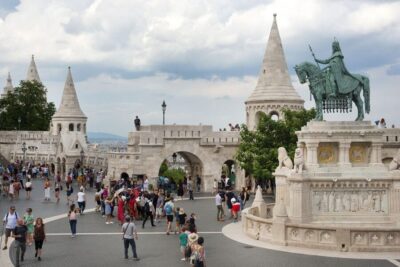 ★ 4.6Buda Castle District Walking TourFrom $142,108 reviews
 ★ 5.0Budapest City Landmarks Walking Tour in 2 HoursFrom $32,048 reviews
 ★ 4.83-Hour Orientation Walking Tour of Buda and PestFrom $411,834 reviews
 ★ 5.0Budapest Historical Sightseeing – Free Walking TourFrom $31,302 reviews
 ★ 5.0Budapest All in One Small Group Walking Tour with Strudel StopFrom $1001,277 reviews
 ★ 4.9Buda Castle District Walking Tour with a HistorianFrom $63867 reviews
 ★ 4.9BloodThirsty Hungary: Walking tour & Dark Historical StoriesFrom $21633 reviews
Browse the lists this tour appears in