
Tour review · TOURS
Past and Present of Budapest Jewish District Tour
Budapest tells its Jewish story on foot. This 1 hour 45 minute walk threads together the Past and Present of Jewish life in District VII with a properly licensed local guide. You start at a landmark square, then move square by square, synagogues by synagogue exterior, with real context for what happened and what remains.
I love two things most. First, the route hits the big names you will hear about anyway, Great Central Synagogue (Nagy Zsinagóga), Rumbach Street Synagogue, and the Kazinczy Street area, plus the memorial spaces connected to them. Second, the guiding style can be personal in the best way, I have seen guides like Eszter, Ester, Dora, and Gary bring the story to life and still make time for questions, even on a topic that carries real weight.
One consideration: this is an exterior-focused walk, not a sit-down museum tour. You will see synagogues from outside, and depending on the guide and the day, you may also spend more time standing and listening than you expect.
Key highlights before you go
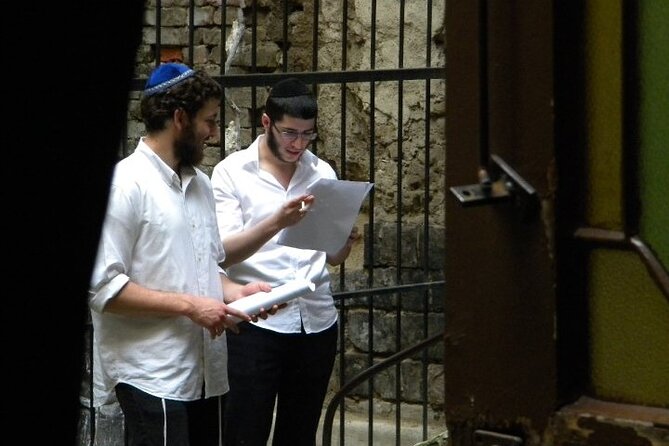
- District VII route that follows a clear timeline, from the Belle Époque and Golden Age toward destruction and what comes after
- Synagogue exteriors, not interior entry, so you get the key buildings without waiting for separate visits
- Holocaust context that stays human, including mention of the Schutzpass that helped save thousands of Jewish lives
- Deák Ferenc Square context with Gaudiopolis, plus the medieval city wall ruins that restricted Jewish trade
- Gozsdu Udvar and the last stretch of ghetto wall, with a bridge from history to modern street life
- Finish at Szimpla Kert, where street art and pop up exhibitions help you reset after a heavy topic
Before the plan settles, compare this with a few more ways to spend time around Budapest.
- Budapest: City Highlights Cruise with Welcome Drink★ 4.6 · 35,610 reviews
- Budapest: Unlimited Prosecco, Beer and Aperol Spritz Cruise★ 4.8 · 25,310 reviews
- Budapest: Széchenyi Spa Day Ticket with Optional Upgrades★ 4.3 · 23,911 reviews
- Budapest: Nighttime or Daytime Sightseeing Cruise★ 4.2 · 21,062 reviews
A 90 Minute Walk Through District VII, Past to Present
If you only have a short window in Budapest, this walk is a smart way to get oriented. You are covering the heart of District VII, moving between major squares and synagogue neighborhoods instead of zigzagging randomly.
The pace is built for seeing multiple sites in one go, with stops that explain what you are looking at and why it mattered. Most people can participate, the group size tops out at 25, and the route stays close to public transport.
This is also a tour where the topic lands with weight. One of the best ways to think about it is that it is not only about buildings and dates, it is about the risks Jews faced and the changes that followed, including Nazi occupation and the Holocaust.
Start at Erzsébet tér, Then Follow the Story’s Roadmap
You meet at the Ferris Wheel of Budapest on Erzsébet tér (Elizabeth Square). That matters because it gives you a big, easy reference point right away, and it is a simple place to regroup if your group splits for a moment.
From the start, the guide typically sketches the route and points out major sights along the way. You are not left guessing what you will see, you get the timeline framing early, including the shift from the Belle Époque or Golden Age toward the destruction that followed.
Expect a mix of architectural description and social history. That combo is what makes the walk feel like more than sightseeing.
Erzsébet tér Stop: Belle Époque Promises and the Turn Toward Destruction
At Elizabeth Square, you begin with the wide-angle story of Jews in Hungary, and how the Jewish community moved through periods of growth, change, and ultimately catastrophic loss.
The way this start works for you is simple. When you later stand outside the synagogue buildings, you can connect the architecture to the human story. It is not just, here is a building, it is, here is what life looked like when the community was thriving, and what was waiting around the corner.
There is also practical value to the way the tour is structured. You will be listening for themes like belonging, restriction, and survival as the walk moves forward.
Deák Ferenc Square: Gaudiopolis, Schutzpass, and City Wall Boundaries

At Deák Ferenc Square, the guide brings in some key ideas that make later stops click.
You will hear the phrase Gaudiopolis, described as a City of Joy in Latin. It is a reminder that Jewish life was not only defined by tragedy. There were cultural and community structures that shaped day to day living.
Then comes Schutzpass. The tour explains that it helped save thousands of Jewish lives, which is crucial context because it shows how survival was sometimes tied to documentation, permissions, and narrow windows of safety.
One of the more specific details here is the former medieval city wall ruins. These ruins mark how the city’s limits excluded Jewish people from trading within the city limits. When you see those remains, you understand that segregation was not only social, it was built into the geography of daily life.
- Budapest: City Highlights Cruise with Welcome Drink
★ 4.6 · 35,610 reviews - Budapest: Unlimited Prosecco, Beer and Aperol Spritz Cruise
★ 4.8 · 25,310 reviews - Budapest: Széchenyi Spa Day Ticket with Optional Upgrades
★ 4.3 · 23,911 reviews - Budapest: Nighttime or Daytime Sightseeing Cruise
★ 4.2 · 21,062 reviews - Budapest: 1-Hour Evening Sightseeing Cruise with Drink
★ 4.5 · 8,330 reviews
Great Central Synagogue Area (Nagy Zsinagóga): Neologue, Orthodox, and Zionism from the Outside
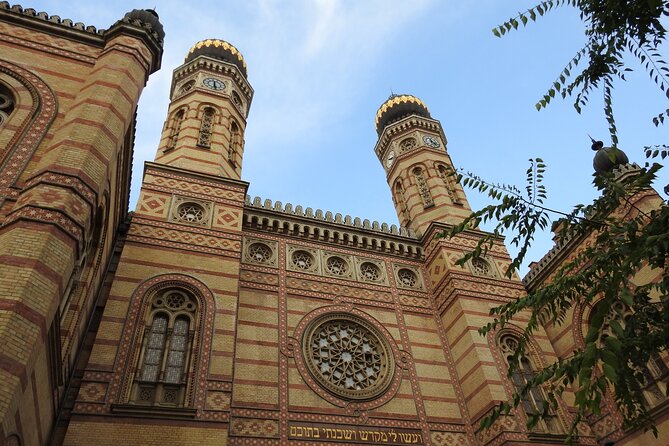
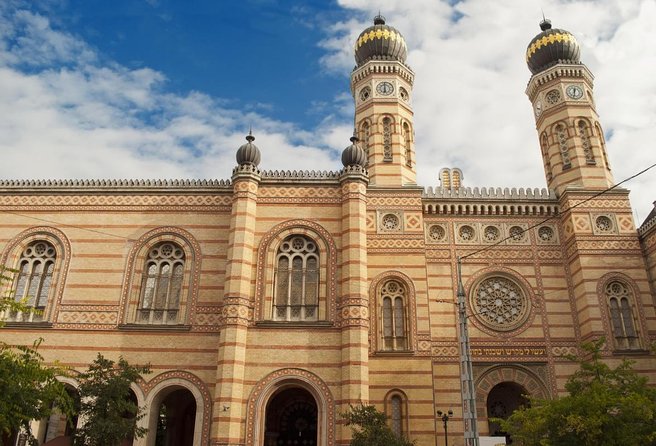
The Great or Central Synagogue stop is the one most people want on their Budapest checklist. Here, you learn what you need to know about the synagogue as the largest synagogue in Europe, and the movements connected to it, including Neologue and Orthodox.
The tour also covers Zionism as part of the broader picture. That helps you connect Budapest’s Jewish story to political and cultural currents that were shaping Jewish identity across Europe at the time.
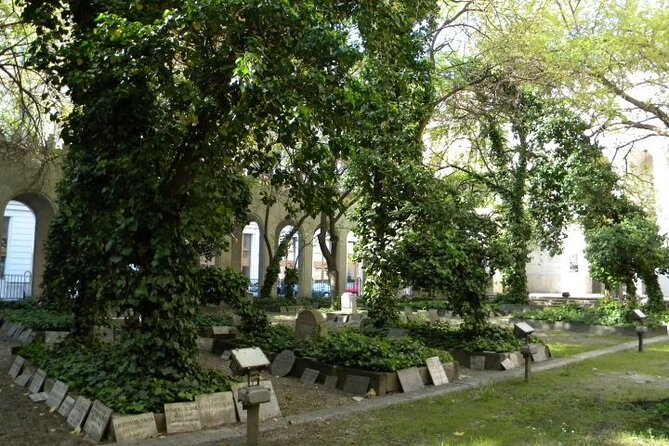
Important practical point: you do not enter the synagogue. Still, you will see the Memorial Courtyard and the cemetery from outside. For many visitors, that is the most emotionally direct part of the route because the memorial spaces carry a different kind of silence than the street.
If you want an experience that feels respectful and focused, this model works. You are not rushing through an interior visit, you are getting context and then meeting the memorial space directly.
Rumbach Street Synagogue: Restored Facade, Murals, and Urban Jewish Life
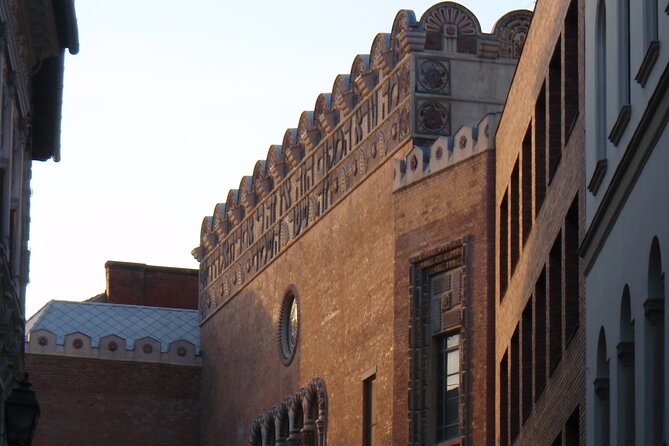
Next up is the Rumbach Street Synagogue area. The focus is on the beautifully restored synagogue and the murals and urban street art around it.
This stop is valuable because it links past and present in a way that feels real. You are standing in a city block that holds visible layers, religious architecture nearby with modern street art. That mix helps you understand how a neighborhood survives by changing, not by freezing in time.
Again, the tour does not enter the synagogue, but the exterior look matters. The guide uses the building to talk about community life and what restoration can mean in a place that has seen disruption.
Gozsdu Udvar: From Ghetto Wall Remains to Modern Passage Life
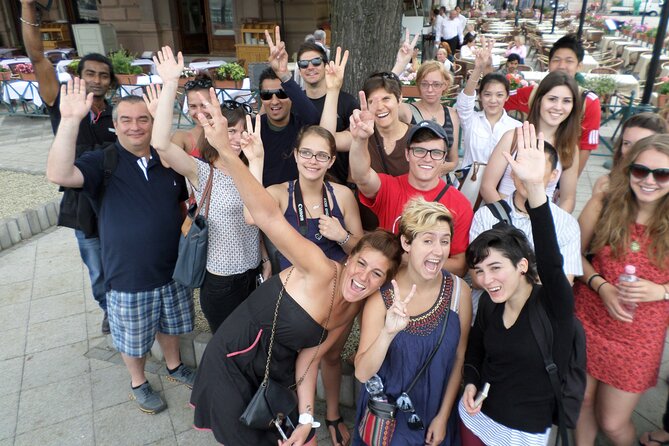
When you pass by Gozsdu Udvar, you are stepping into a place that now mixes entertainment, gastronomy, and culture. But the tour uses it to explain the past, including the last piece of the ghetto wall that you will see along the way.
That combination is powerful. You are literally walking through the present-day city while learning where the walls used to be and what those barriers represented. It is the kind of detail that turns an ordinary street into a story you will remember.
You will also get an orientation feel here. Even if you are not a planner, this is where you start to sense how District VII is stitched together.
Kazinczy Street Synagogue Area: Orthodox Community Details and Ritual Practice
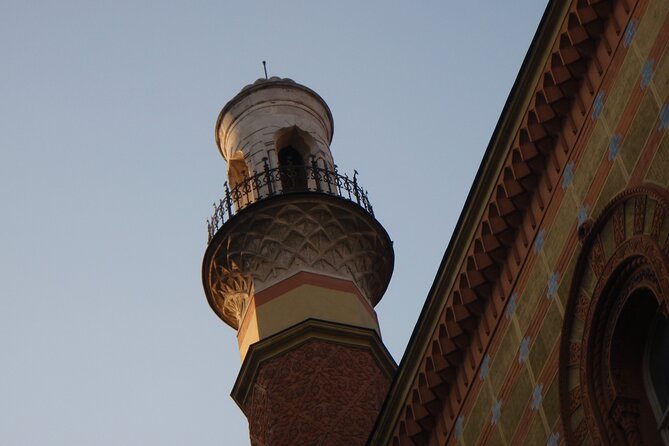
You stop just outside the Kazinczy Street Synagogue, tied to the Orthodox community of around 50 to 60 families. That scale point helps you avoid vague stereotypes. This was not only one large institution, there were smaller community structures with distinct practices and needs.
The guide also covers kosher food and Jewish ritual bath, which makes the stop more than a quick building sight. You get an idea of how daily ritual shaped life, not just how people worshipped on a schedule.
As with the other synagogue stops, you do not enter. You are observing and learning from the street view, which can be a benefit if you want history without extra waiting around.
One tip for getting the most from this part: keep listening for the practical meanings behind the terms. When the guide explains what ritual objects or practices are for, the neighborhood stops feeling like a set of trivia facts.
Szimpla Kert Finish: Street Art, Pop Up Culture, and a Reset Moment
The tour ends at Szimpla Kert, a ruin bar. There is no entry fee for simply being there, and the point is to give you a clean finish with a lively modern atmosphere.
This is where you may see pop up exhibitions. Even if you do not go inside, the surroundings help you reset after a walk that can feel heavy.
The guide often provides a final orientation here. It helps you decide what to do next, whether you stay in the area for another look or head back toward other parts of Budapest with a clearer mental map.
Also, if street art and small details are your thing, you might get pointers during the walk. Some guides are the kind who mention things like hidden mini statues by Mihály Kolodko or the concept of stumbling stones as things to look for later on your own.
Price, What You Really Get, and Donation-Based Value
The listed price is $3.63 per person. That sounds low, and the real value is not the cash price alone, it is how much ground you cover in a short time with a licensed local guide.
You do get a mobile ticket, and group discounts are part of the offering. The booking fee is included, and it is directed toward administration rather than the guide’s earnings. That is why the tour also runs on optional donations at the end.
In practice, think of this as a guided walk where the quality hinges on your guide. In the feedback I have read, names like Eszter, Ester, Dora, Gary, Edith, Christine, Edi, Judith, and David come up again and again, with emphasis on organized pacing and clear answers to questions. If your guide is strong at explaining, you will feel like you are buying real insight, not just walking time.
If you are budget conscious, this price structure can be a win. If you prefer tours where everything is ticketed and closed-loop, you might want to understand up front that you will mostly be experiencing exteriors and walking, not paying for a bundle of internal admissions.
Group Size, Timing, and Why Comfortable Shoes Matter
Plan for roughly 1 hour 45 minutes, give or take. The tour runs as a group experience with a maximum of 25 travelers, so you will not feel like you are alone, but you also will not be stuck with a huge crowd.
Most travelers can participate, and it is near public transportation, which helps if you want to connect it with other stops in the city. Service animals are allowed, which is good to know if that applies to your group.
Shoes are the practical key. This is not a sit-and-stare tour. You will move between squares and streets, and even the people in the group who cared about comfort said they appreciated a pace that could work for seniors.
If you know you struggle with long standing and listening, you might do well choosing a lighter day schedule around it and planning a quiet drink break afterward at Szimpla Kert.
Guide Style: Where You Can Ask Questions and Get More Than Facts
The strongest part of this tour is often the guide. Multiple guides were praised for friendliness, professionalism, and staying ready to answer questions.
Some guides, including Gary and David, were specifically described as passionate and fun while still covering sensitive material. Others, like Dora and Edith, were praised for organization and clear structure, so you leave with a coherent timeline rather than a scattered set of stops.
There is one downside to watch for. A small number of experiences mentioned difficulty understanding due to a strong accent. That does not mean you will have the same issue, but it is a good reminder to choose your meeting spot early, stand where you can hear clearly, and ask questions when something does not land.
If you care about the personal side, you may also want to engage the guide directly. Some people felt the tour stayed more factual than personal, so asking about everyday life, community organization, or what symbols meant can push it toward the level of connection you want.
Who This Tour Fits Best in Your Budapest Plan
This is a great match if you want a first, smart orientation to Jewish District VII without committing to multiple separate museum stops.
It fits especially well if:
- you like history that explains why buildings and neighborhoods exist
- you want a short walk that covers multiple synagogue areas
- you are visiting for the first time and need a clear map in your head afterward
- you care about both cultural life and the tragic events that followed
It may be less ideal if:
- you expected to go inside synagogues
- you want a lighter, purely celebratory walk
- you dislike heavier topics, since Holocaust-era history is part of the story
Should You Book the Past and Present of Budapest Jewish District Tour?
I recommend booking it if you want a short, focused way to understand District VII as more than a postcard. The mix of Erzsébet tér framing, key synagogue exteriors like Nagy Zsinagóga, and the ghetto-era reminder of the ghetto wall makes the walk feel purposeful.
Book it with realistic expectations: this is an exterior itinerary that ends at Szimpla Kert, not a multi-hour synagogue interior tour. If you want to go inside, you can plan that separately, but this walk is a strong foundation.
Finally, pick it on a day when you can listen. The story is meaningful, and the best experience comes when you let the route do its work instead of treating it like a quick photo run.
FAQ
How long is the Past and Present of Budapest Jewish District Tour?
It lasts about 1 hour 45 minutes.
Where does the tour start?
The meeting point is the Ferris Wheel of Budapest at Erzsébet tér, 1051 Hungary.
Where does the tour end?
The tour ends at Szimpla Kert, Kazinczy u. 14, 1075 Hungary.
Does the tour enter the synagogues?
No. It does not enter the synagogues, but you will see memorial courtyard areas and cemeteries from outside.
What language is the tour offered in?
The tour is offered in English.
How big is the group?
The tour has a maximum of 25 travelers.
Is there a mobile ticket?
Yes, it includes a mobile ticket.
Is tipping included in the price?
Tips are not included. Guides depend on donations at the end of the tour, and the amount is your choice.
What accessibility details are mentioned?
Service animals are allowed, and it is near public transportation. Most travelers can participate.
Can I get a refund if I cancel?
Free cancellation is available up to 24 hours in advance for a full refund.
How far in advance do people usually book?
On average, it is booked 10 days in advance.
More Tours in Budapest






More Tour Reviews in Budapest






Recently added around Budapest



Tours, compared.
 ★ 4.7Buda Castle Cave TourFrom $195,677 reviews
 ★ 4.1City Sightseeing Hop-On Hop-Off Bus Tour & ExtrasFrom $414,337 reviews
 ★ 4.6Buda Castle District Vampires and Myths Night TourFrom $233,830 reviews
 ★ 4.2Big Bus Hop-On Hop-Off Tour & Danube River CruiseFrom $403,794 reviews
 ★ 4.3Floating Bus Tour by Land and WaterFrom $283,342 reviews
 ★ 3.5Big Bus Budapest Hop-On Hop-Off Bus and Walking TourFrom $422,206 reviews
 ★ 4.6Buda Castle District Walking TourFrom $142,108 reviews
 ★ 5.0Budapest City Landmarks Walking Tour in 2 HoursFrom $32,048 reviews