
One day, Budapest hits different. This full-day private tour strings together major landmarks across Pest and Buda by air-conditioned car, so you waste less time on transit and more time actually seeing the places. You can also shape the route along the way, which matters when Budapest weather or your interests shift.
I especially like how the day is built for efficiency without feeling like a checklist. With your guide Emise, you get friendly, real cultural context, not just names and dates, and it helps you understand why each spot matters. I also like that in at least one group, the guide spoke Spanish, which made interaction and questions easier.
The main thing to weigh is pacing. Many stops are quick, and at several big-ticket sights, admission is not included, so you may still need to budget for entry if you want to go inside.
Key highlights if you want a fast, guided hits-tour
- Private car, just your group, with pickup offered and a route that can be adjusted
- A guide makes it click, with plenty of culture and context (Emise is a standout name)
- Traditional Hungarian lunch included during the day so you are not scrambling for food
- Mix of free photo stops and paid entries, so you can decide what to enter
- Crossing Pest and Buda in one day, instead of piecing it together on public transport
Other Budapest days with the guide to yourself
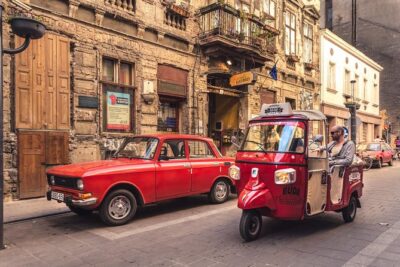
- Private Budapest TukTuk Tour: Custom Route, Hotel Pickup★ 5.0 · 1,307 reviews
- Budapest Essentials Private Tour Highlights and Hidden Gems★ 5.0 · 861 reviews
- Private Budapest City tour with Classic Russian Jeep or G-Wagon!★ 5.0 · 386 reviews
- Private city tour by van★ 5.0 · 273 reviews
Why a private car solves Budapest’s sight-hopping problem
Budapest is gorgeous, but it is spread out. If you try to do it all by public transport, you end up spending a lot of time waiting, transferring, and timing buses and trams around your lunch and bathroom breaks.
This is a full-day private drive, so your day runs on car time, not schedule math. Pickup is offered, and you move between stops without dragging your daypack across the city. You also get the comfort of an air-conditioned car, which you will appreciate if your visit hits a hot summer day.
The other win is flexibility. The tour route can be customized, which is helpful when you want more time near the Danube views, or you want to shift things around if you are tired after a couple of museums or churches.
Heroes’ Square, Andrássy Avenue, and the grand first impression
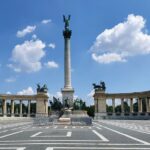
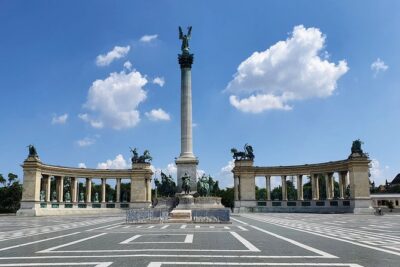
Your day starts at Heroes’ Square, Hősök tere. It is one of Budapest’s most iconic civic spaces, known for the statue complex of the Seven chieftains of the Magyars and other major Hungarian national leaders. There is also a Memorial Stone of Heroes, which people sometimes wrongly call the Tomb of the Unknown Soldier.
This stop is brief, about 15 minutes, and admission is free. That is perfect for a quick orientation moment. You get the visual anchor for the city’s national story before you head into the more everyday streets and architecture.
From there, you pass through Andrássy Avenue, Andrássy út. The boulevard dates back to 1872 and links Erzsébet Square with Városliget, and it is a World Heritage Site (recognized in 2002). This is the kind of place where walking for five minutes makes you feel like you stepped into a different era.
The stop is only about 10 minutes, admission free. If you are the type who loves building facades, you might wish you had more time to walk it slowly, but for many people this is a smart trade, because the day still covers both the famous views and the major landmarks.
Széchenyi Baths and Pool: big-time classic, but plan for tickets
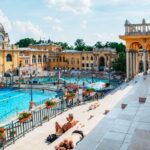
Széchenyi Medicinal Bath is stop two, with about 10 minutes on the schedule. The numbers here explain why it is such a magnet: it is the largest medicinal bath in Europe, and the water comes from two thermal springs with temperatures of 74 °C (165 °F) and 77 °C (171 °F).
Admission is not included, so think of this as a photo-and-brief-stop window unless you add time and pay separately to access the baths. That can still be worth it, especially if you want the location in your mental map for later.
If baths are your top priority, you will likely need a longer visit than this day provides. But if your goal is to hit the city’s greatest hits in one go, this quick stop helps you say you saw Széchenyi, and you get a clearer sense of how monumental the complex is.
Vajdahunyad Castle and City Park vibes without the time sink
Next up is Vajdahunyad Castle, in City Park, with about 15 minutes. The castle dates to the 1896 Millennial Exhibition, created to celebrate 1,000 years of Hungary since the Hungarian Conquest of the Carpathian Basin in 895.
Admission is not included, which matters if you were hoping to go inside. Still, even from outside, this is a strong “Budapest postcard” moment, and it gives you a break from nonstop urban streets.
Because the day is private and by car, you are not losing time to transit on the way to City Park. That is a real value here. You get the setting without the overhead of planning how to get there and how long you need to walk and regroup.
More days handed to a private guide
- Budapest Private Tuk Tuk Half-Day Tour
★ 5.0 · 606 reviews - Budapest One Way Private Transfer to or from Airport
★ 4.5 · 548 reviews - Budapest Private Luxury Sightseeing Tour with Guide and Transport
★ 5.0 · 442 reviews - Budapest Private Full Day City Sightseeing Tour Walking or by Car
★ 5.0 · 299 reviews - Private photography photo session at Fisherman Bastion
★ 5.0 · 269 reviews
St. Stephen’s Basilica, the State Opera, and Liberty Square to Parliament
As the route moves toward the city center, you get classic highlights stacked close enough to make a day like this work.
You spend about 15 minutes at the Hungarian State Opera House, on Andrássy út. The building is neo-Renaissance and was originally known as the Hungarian Royal Opera House. It was designed by Miklós Ybl, a major 19th-century Hungarian architect. Admission is not included, so this is best for seeing the exterior and learning what you are looking at, then deciding if you want to pay for entry.
Then it is St. Stephen’s Basilica, with about 15 minutes. It is named for Stephen, the first King of Hungary (c 975–1038). The reliquary houses his right hand, which is a detail that instantly turns a church stop into something more specific than just architecture. Admission is not included, so treat it as a look-and-absorb moment unless you add tickets separately.
Liberty Square, Szabadság tér, comes next, about 20 minutes and free to visit. You will see the United States Embassy in Hungary and the historicist style headquarters of the Hungarian National Bank about the west side of the square. This stop has a useful purpose: it frames the political and institutional face of the city before you head to the big symbol of national power.
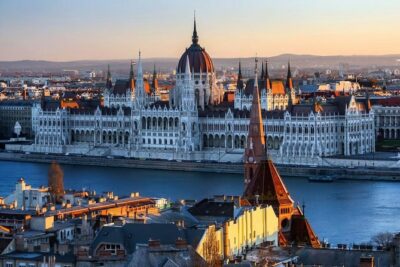
That final step of this block is the Hungarian Parliament Building, Országház, about 20 minutes. Admission is not included. Even if you do not go inside, you get a solid view and time to understand the building as a landmark that anchors Budapest’s civic identity.
Széchenyi Chain Bridge and the Great Synagogue quick-hit stops
The route crosses to bridge-and-panorama mode with the Széchenyi Chain Bridge, Széchenyi lánchíd. The bridge spans the Danube between Buda and Pest. Admission is free, and the stop is about 15 minutes.
This is one of the most useful “car tour” moments. You get a Danube crossing with minimal effort. And because the day already includes Buda Castle later, this bridge stop helps you connect the river’s role in separating and linking the two sides of the city.
Then you move to the Great Synagogue, also known as the Dohány Street Synagogue (Nagy Zsinagoga). The stop is about 15 minutes, and admission is not included. It is a historical building in Erzsébetváros, and this is one of those stops where even if you only spend a short time outside or in the immediate area, it helps balance the day’s emphasis on churches and state buildings.
If you care about religious and cultural landmarks, this quick stop is a smart inclusion for a greatest-hits day. If you want deeper time, you will want to plan an extended visit on another day.
Citadella, the Liberty Statue, and Gellért Hill viewpoints
Next the tour climbs to Gellért Hill with the Citadella, the fortification on top. The stop is about 25 minutes and admission is free. Citadella is the Hungarian word for citadel, and it sits on a strategic location with military importance in Budapest’s history.
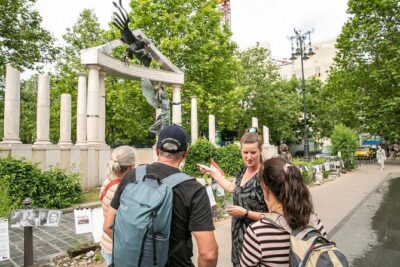
Then you get the Liberty Statue, Freedom Statue, also on Gellért Hill. Admission is free, with about 15 minutes. The monument commemorates those who sacrificed their lives for Hungary’s independence, freedom, and prosperity. This is the kind of moment that turns a viewpoint visit into a meaning-based stop, not just sightseeing.
These are outdoor and scenic stops, and they can be a strong payoff on a day when the schedule is otherwise tight. Just remember that “free” does not mean “no effort.” You will likely do some walking uphill, so wear shoes you trust.
Matthias Church and Buda Castle District: where the views do the talking
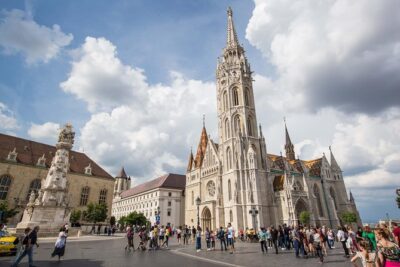
The day shifts fully into Buda Castle District mode with Matthias Church. The stop is about 10 minutes and admission is not included. Matthias Church is the Church of the Assumption of the Virgin, also known as Mátyás-templom, and it sits in Holy Trinity Square in front of Fisherman’s Bastion.
This stop is short, but it helps you frame what you will see next. You are not just walking through a tourist zone, you are arriving at a cluster of landmarks that work as a single dramatic area.
Then it is Buda Castle, Budavári Palota, with about 15 minutes. The site has earlier roots, with the first completion in 1265, but the major Baroque palace you see today was built between 1749 and 1769. Admission is not included, so you may mostly use the time to orient, photograph, and decide if you want to return later for deeper exploration.
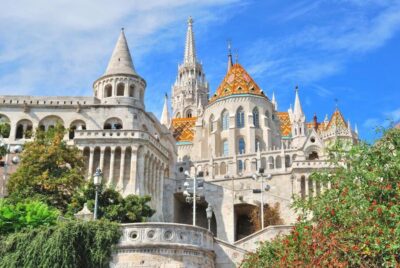
Finally, you reach Fisherman’s Bastion, Halászbástya. It is one of Budapest’s most famous viewpoints, known for the Neo-Romanesque lookout terraces and the panorama over the city. The stop is about 15 minutes and admission is free.
For many first-timers, this is the emotional peak of the day. Even if you only have a limited time window, the terraces give you an immediate “wow, that is Budapest” moment. And the best part of doing it on a private schedule is that you still have other major stops to hit afterward, instead of sacrificing the whole day to this one area.
Central Market Hall: a practical finish with food-shopping energy
To close the day, you visit Central Market Hall, also called Great Market Hall or Nagyvásárcsarnok. The stop is about 15 minutes, admission free.
This is the city’s largest and oldest indoor market. The idea for building such a large market hall came from Károly Kamermayer, Budapest’s first mayor, and it was his biggest investment. He retired in 1896 and attended the opening ceremony on February 15, 1897.
This final stop is a smart choice if you like having something tangible at the end of a sightseeing day. Even if you do not do heavy shopping, it gives you a sense of everyday Budapest food culture, and it is a nice indoor option if the weather turns.
If you want to linger, you might find yourself wishing for more time here, but as a wrap-up stop it fits well. It is free, central to the city rhythm, and not dependent on timed entry tickets.
Lunch and pacing: the part that decides if the day feels good
This tour includes a traditional Hungarian lunch along the way. That matters more than it sounds. When you are hopping landmarks from Pest to Buda, a real sit-down meal keeps the energy up and prevents the classic late-afternoon hangry spiral.
Pacing is the trade-off in a greatest-hits day. Many stops are about 10 to 20 minutes, with a couple exceptions such as Citadella at around 25 minutes. This does not mean you will not learn things. It means you are in a “see and understand enough to want more” mode, not a “stay two hours in each place” mode.
If you are the type who likes to go inside every church, museum, or landmark, you should treat this as the framework day, then plan follow-up visits. If your goal is to get oriented fast and enjoy the core sights without the transit headaches, this structure works well.
Also pay attention to the pattern: the tour mixes free stops, like Heroes’ Square and Fisherman’s Bastion, with places where admission is not included, like Széchenyi Baths and the major indoor landmarks. That gives you control over what you pay for.
Price and value for $280.59 per person
At $280.59 per person, this is not a budget tour. But you are buying a very specific thing: a full day of private driving, pickup, and guided pacing across a city that can be time-consuming on public transport.
Here is the practical value equation I use:
- You save commuting time between dispersed sights by using a car with an efficient route.
- You reduce stress because you do not have to manage transit connections all day.
- You get a guide for context, and the Emise mention is a real signal that the tone is friendly and explanatory.
- You get lunch included, which is often where self-guided days quietly cost more than you expect.
If you are traveling with another person or two, this becomes easier to justify because the private-car cost is shared within your group. The tour also mentions group discounts, so ask what applies to your party size.
If you are solo and your priority is deep museum time at multiple paid sites, you might decide to do a lighter independent route. But if you only have one day and you want the city’s main highlights without the logistics crunch, this price starts to make sense.
Who this tour is for, and who should skip it
This tour is a great fit if you:
- Have limited time in Budapest and want a high-impact day
- Prefer private comfort over public transport juggling
- Like being guided through major landmarks with cultural context
- Want lunch handled, not researched
You might skip it or plan a different style if you:
- Want long, slow stays inside multiple major paid attractions
- Hate quick stops and prefer only walking tours with minimal driving
- Plan to spend most of your time at one venue, like baths, churches, or markets
The sweet spot is a traveler who wants coverage plus understanding, with a plan that keeps you from wasting the day stuck in transit.
Should you book Budapest Greatest Hits by private car?
I would book it if your trip schedule is tight and you want Budapest’s most famous sights stitched together in one day with a guide who keeps things human and informative. The private format plus car time is the big reason to choose it, and the included traditional Hungarian lunch helps the day feel complete.
If you do book, come with a smart expectation: you are going to see a lot, but you are not going to deeply explore every interior. Bring your ticket-purchase flexibility for the sites where admission is not included, and wear shoes for some walking, especially on Gellért Hill.
FAQ
How long is the Budapest Greatest Hits private tour?
It lasts about 7 hours.
What is the price per person?
The price is $280.59 per person.
Is this tour private?
Yes. It is a private tour, and only your group participates.
Is pickup offered?
Yes, pickup is offered.
Is there an air-conditioned car?
Yes, the tour includes rides in an air-conditioned car.
Is lunch included?
Yes. A traditional Hungarian lunch is included along the way.
Do I receive a mobile ticket?
Yes, mobile ticket delivery is listed as part of the experience.
Are admission tickets included for every stop?
No. Some stops are free, while others list admission tickets as not included.
Is Széchenyi Baths admission included?
No. Admission to Széchenyi Baths and Pool is not included.
What is the cancellation policy for a full refund?
You can cancel up to 24 hours in advance for a full refund.
More Tours in Budapest
More Private Days in Budapest



More Tour Reviews in Budapest




Recently added around Budapest


Budapest Private Tours, compared.
 ★ 5.0Private Budapest TukTuk Tour: Custom Route, Hotel PickupFrom $991,307 reviews
 ★ 5.0Budapest Essentials Private Tour Highlights and Hidden GemsFrom $116861 reviews
 ★ 5.0Private Budapest City tour with Classic Russian Jeep or G-Wagon!From $256386 reviews
 ★ 5.0Private city tour by vanFrom $181273 reviews
 ★ 4.9Private City Tour with a Vintage Russian JeepFrom $318246 reviews
★ 5.0Budapest Private City Tour With a Vintage Russian JeepFrom $261198 reviews
★ 4.9Private City Tour with a Vintage Russian JeepFrom $318246 reviews
★ 5.0Budapest Private City Tour With a Vintage Russian JeepFrom $261198 reviews
 ★ 4.7Private City Tour with Local GuideFrom $222186 reviews
 ★ 5.0Grand Segway Tour of Budapest – Private Tour with Coffee StopFrom $107163 reviews
Browse the lists this tour appears in