
Tour review · BUDAPEST WALKING TOURS
Communist Budapest Walking Tour
Budapest hides a second city in plain sight. This 3-hour Communist Budapest Walking Tour uses major squares, Cold War landmarks, and everyday housing to explain how totalitarian rules still left room for small liberties. You’ll connect the dots from the early stirrings of 1956 to the later signals of control, ending at the House of Terror.
I especially like the historian-led format. Guides include professors, doctoral students, historians, journalists, art critics, and published authors, so the talk stays grounded in real context instead of vague slogans. I also like that guides can adjust to what you already know, which matters a lot on a topic this layered, and I’ve seen this turn a walking tour into something you can actually remember.
One thing to consider: if you already have a strong base in Hungary’s post-World War II to 1989 story, you may feel the tour sticks to the essentials at some points. The route is packed, and some guides may focus more on getting through key sites than on the deeper “what changed day to day” details you might want.
Key moments you will not forget
- Bem József Square to 1956 uprising energy, including a preserved coffeehouse interior from the 1960s
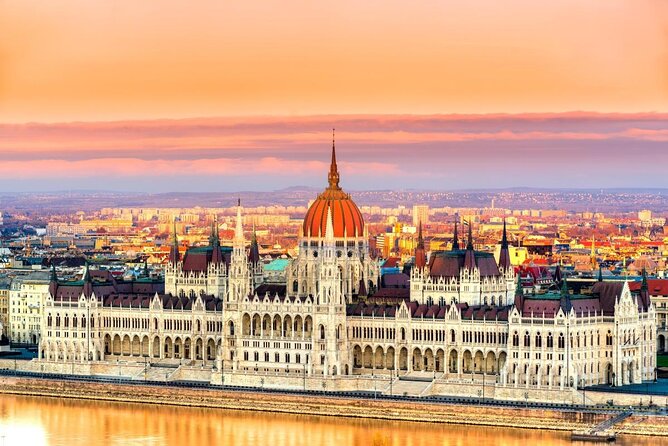
- Kossuth Square and Parliament-area monuments, tied directly to the revolution’s political and armed conflict
- Freedom Square’s four Cold War stone statements, from the U.S. embassy to a Reagan statue and an atomic shelter entrance
- 1970s housing estates at the city edge, where elevators and basic modern comforts meant real hope for young families
- Puskas Soccer Stadium grounds and Social Realist statuary, showing how art served ideology
- House of Terror and the Berlin Wall slab, a hard, focused ending at the former secret services HQ
Budapest on foot, with a few more routes to compare
- Big Bus Budapest Hop-On Hop-Off Bus and Walking Tour★ 3.5 · 2,206 reviews
- Budapest: Buda Castle District Walking Tour★ 4.6 · 2,108 reviews
- Budapest City Landmarks Walking Tour in 2 Hours★ 5.0 · 2,048 reviews
- 3-Hour Orientation Walking Tour of Buda and Pest★ 4.8 · 1,834 reviews
Bem József Square and the 1956 spark you can still feel
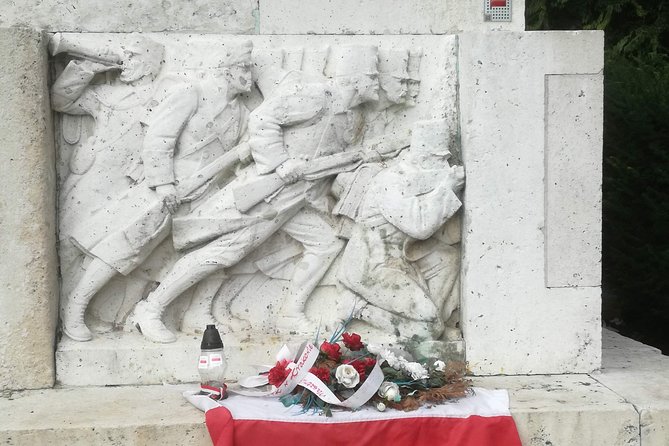
The tour starts at Bambi Eszpresszó (Frankel Leó út 2/4, 1027). The area is convenient, but the real payoff is the historical starting point. Bem József Square is where one of the first large demonstrations of the 1956 uprising took shape, which gives you instant perspective on why political control mattered so much to ordinary people.
From there, you’ll hear how the decade under communist rule worked as a system, not just a set of events. You’re not only studying history on paper. You’re walking through spaces that helped shape decisions, protests, and consequences.
One of my favorite details on this part of the route is the stop at a coffeehouse with an interior that retained its look from the 1960s. That kind of preservation is rare. It also makes a simple point: even in a tightly controlled era, everyday social life still had its own rhythm. The guide uses small, specific clues like this to connect ideology to real human routines.
Kossuth Square, Parliament, and the revolution’s visible scars
Next you take the metro to Kossuth Square, one of Budapest’s political stages. In front of Parliament, you’ll focus on monuments that point to the political and armed conflicts of the 1956 revolution. This is where the tour shifts from “what communism claimed” to “how people pushed back” and what the world saw.
Here’s the trick that makes this section work. Instead of treating monuments as decoration, the guide links them to the stories of confrontation and negotiation. You’ll understand why these symbols still matter, because the meanings were designed to last.
If you’re the type who likes to ask good questions, this is a great moment to do it. Ask your guide what the revolution meant to the government at the time, and what it meant to families who were trying to live through it. The best guides can bring it alive in plain language.
Freedom Square and the Cold War puzzle of four stone structures
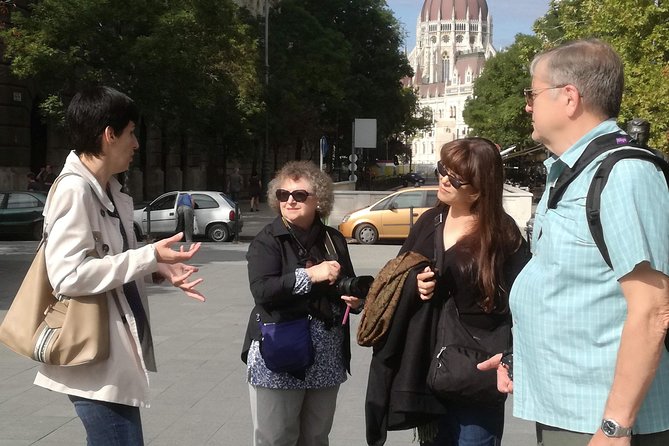
A short walk takes you to Freedom Square, where Cold War symbolism is not subtle. You’ll see four stone structures that are basically a timeline in architecture: the U.S. embassy, a monument to the Soviet army, a statue of President Ronald Reagan, and the entrance to a secret atomic shelter.
I like this stop because it forces you to notice how power talks to people through public space. Even if you know the broad Cold War story, these specific markers make it feel local and immediate. You can stand in the middle of the same kind of messaging that shaped fear, propaganda, and hope.
This is also where the tour’s theme becomes clear: communist Budapest was shaped by bigger forces, but those forces played out in targeted, human-scale ways. Think about it like this. You’re not just observing global politics. You’re seeing how a city tells its residents what to think and what to fear.
1970s housing estates: drab from afar, life-changing up close
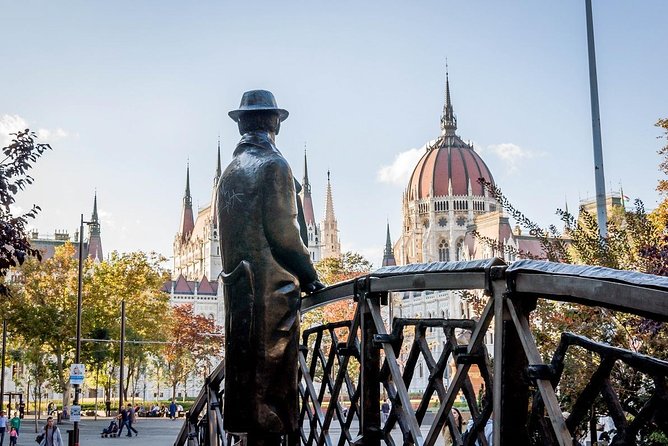
The metro ride continues to one of the 1970s housing estates at the edge of the city center. Today, the apartment blocks may look grey and flat. But the guide will explain why, back then, young Hungarian families felt real excitement when they were awarded apartments here.
This part matters because it gives you a different angle on communist life. Yes, there were restrictions and pressures. But there were also practical promises, like improved housing standards. The key is that the tour shows how modern conveniences that were rare in older Budapest buildings, like elevators, helped make the system feel livable to people who needed stability fast.
You’ll likely find yourself looking at the buildings in a new way. Instead of judging from a modern aesthetic standard, you’ll try to picture what it meant to step into a better apartment, even if political freedom was limited. That tension is the point.
More of Budapest behind the Iron Curtain
- Budapest: Communist History Tour with House of Terror Option
★ 4.8 · 182 reviews - Communism in Hungary with a Historian
★ 5.0 · 70 reviews - Budapest: 3-Hour Walking Tour About Communism (Small Group)
★ 4.7 · 70 reviews - Budapest Hammer & Sickle Communist Times Tour
★ 4.5 · 68 reviews - Lives of Hungarians Under Communist and Capitalist system
★ 5.0 · 59 reviews
Puskas Stadium and the art of heroic workers
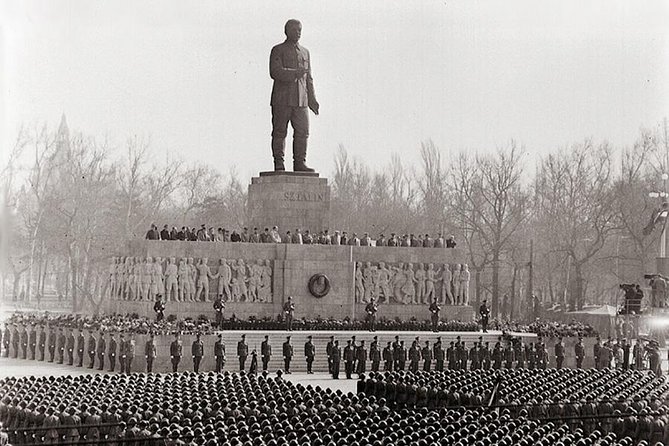
Later you visit the former People’s Stadium, now Puskas Soccer Stadium. This is one of the easiest places in town to spot Social Realist statues created to promote the communist worldview. You’ll see heroic workers, soldiers, and intellectuals, all pointing the way toward a bright future.
Art like this was never neutral. It was a communication tool. On the tour, you’ll learn how these figures were designed to tell people who mattered, what “good” looked like, and which future to want.
One reason this stop stands out is that it lets you read propaganda without needing a lecture hall. If you pay attention to the poses, symbols, and the kinds of people portrayed as heroic, you’ll start recognizing the same logic in other communist-era art you may see later in Budapest.
Stalin-era streets, May Day parades, and old photos that hit harder
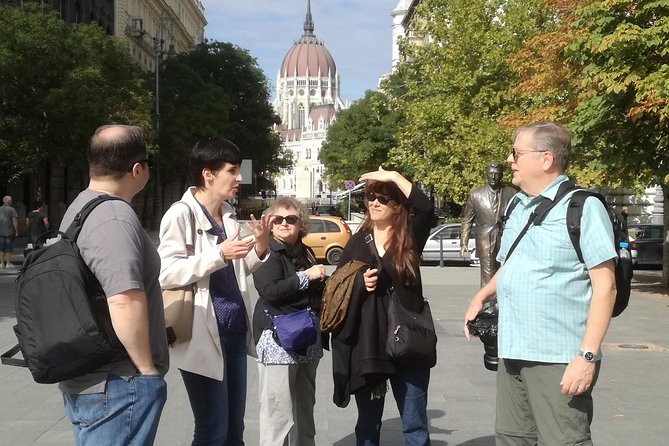
Then comes one of the more memorable moving segments. You’ll take a short ride in one of Stalin-era trolley buses to Dozsa György Street, the broad boulevard used for May Day parades. You’ll hear how major holidays were staged to show unity, strength, and the inevitability of the system.
This is also where the tour’s teaching method becomes very practical. Your guide uses an iPad and old photos to show you how the city looked in the Stalin era compared to today. When you can see the visual differences, it becomes harder to reduce the period to textbook terms.
Here’s my practical advice. Wear comfortable shoes for this part and take a breath when you need to. You’ll walk enough that by the end you feel it, even on a relaxed pace. That’s not a problem, just reality. In fact, some people end the tour tired because there’s a lot of information mixed into the walking.
House of Terror: the end of the line for real-world consequences
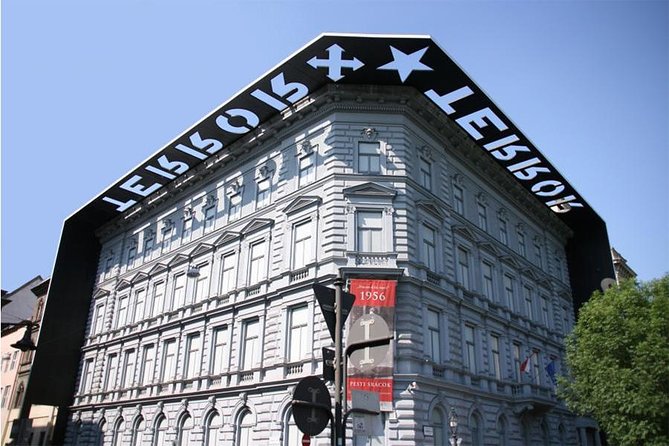
The last major stop is around the corner: the House of Terror, a museum housed in the former headquarters of the secret services. It commemorates the crimes of communism, especially during the Stalinist years.
It is a heavy ending, on purpose. The tour doesn’t just point at ideology. It points at what ideology did in practice: surveillance, intimidation, and punishment. You’ll see a slab of the Berlin Wall in front of the building, which adds another layer to the message. It links Budapest’s story to a wider system of Cold War repression.
If you want a way to process what you saw, do it right after you leave. Take five minutes to jot down the stops that changed your thinking the most. The tour covers public squares, housing, stadium statuary, and museums, and your brain will piece them together later when you’re back at your hotel.
Price, pace, and whether $123 is worth it for you
At $123 per person for about 3 hours, this tour isn’t cheap, but it can feel fair if you care about context and you like to learn with a guide who can explain what you’re looking at. The tour includes a 3-hour walking route plus a historian guide, which is the cost driver.
What is not included is simple: tram and metro tickets. Since part of the itinerary uses metro and a trolley bus, you’ll want to budget for transit fares separately. Also, because you’ll be walking, bring shoes that can handle uneven sidewalks and longer stretches.
In terms of pace, the experience can feel conversational. One guide example that comes up often is András, whose style leans toward relaxed pacing and adapting the route when people want more connections. That flexibility is a big part of the value. A good guide can use the same sites to explain the evolution of control and the lived experience of it, rather than treating the tour as a checklist.
At the same time, I respect the honest edge here. If your background is already strong, you may want the guide to go beyond basics. Don’t be shy about steering the conversation. Ask how everyday life worked in the era you’re most curious about, or what changed between early communist years and later decades.
Who this Communist Budapest walk fits best
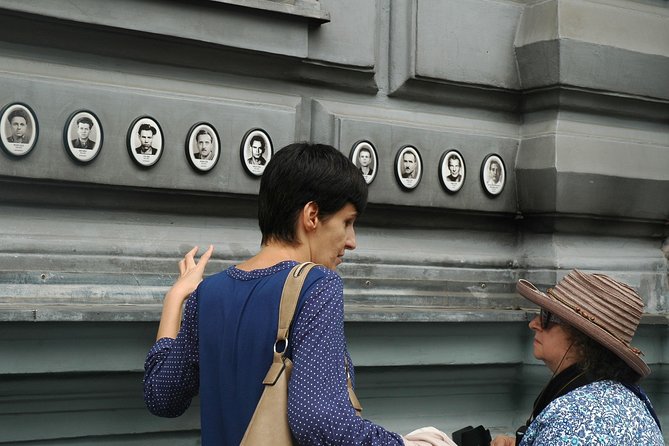
This is a strong choice if you want more than dates. You want to see how communism shaped public space, housing, public ceremonies, and symbolism from 1956 onward. The itinerary is designed to show cause and effect across different kinds of locations, not just one political site.
It also works well if you enjoy museums and art details. The Social Realist statues and the House of Terror give you two angles on propaganda and consequences. If you like connecting visual clues to political intent, this tour will reward your attention.
The tour is offered in English, and it can be private or small groups. That matters because the most satisfying version of this walk is when the guide can match your starting point. Some guides clearly do this well, including by tuning explanations based on what participants already know.
If you’re an experienced Hungary-history nerd, go in with specific goals. Pick your focus: 1956, everyday housing life, the Cold War messaging around Freedom Square, or the mechanisms described through the House of Terror. Then ask targeted questions as you go. That way, you get the most from the time you spend.
Should you book the Communist Budapest Walking Tour?
Book it if you want a guided, site-by-site explanation of how Budapest worked under communism, and how that legacy shows up in monuments, buildings, and museums. The combination of Bem József Square, Freedom Square, 1970s housing estates, Puskas Stadium’s Social Realist statuary, and House of Terror gives you a full-spectrum view that’s hard to assemble on your own.
Think twice if you already know the period very well and you mainly want new, deep detail about day-to-day life that goes well beyond what these sites usually explain. In that case, still consider booking, but come prepared with questions, and be ready to steer the guide toward the parts you care about most.
FAQ
FAQ
How long is the Communist Budapest Walking Tour?
It lasts 3 hours.
Where does the tour meet?
The meeting point is Bambi Eszpresszó, Frankel Leó út 2/4, 1027 Budapest, Hungary.
What is included in the price?
The 3-hour walking tour and a historian guide are included.
Are tram and metro tickets included?
No, tram and metro tickets are not included.
What language is the guide?
The tour is offered in English.
What stops are part of the itinerary?
You will visit Bem József Square, Kossuth Square (Parliament area), Freedom Square, the 1970s housing estates on the edge of the city center, the former People’s Stadium (now Puskas Soccer Stadium), and the House of Terror.
Is this tour only for large groups?
No. Private or small groups are available.
Can I cancel for a full refund?
Yes. There is free cancellation up to 24 hours in advance for a full refund.
More Communist-Era Budapest



Keep Walking Budapest



More Tour Reviews in Budapest






Recently added around Budapest


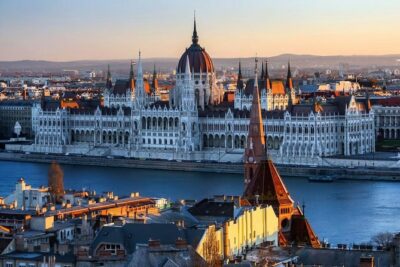
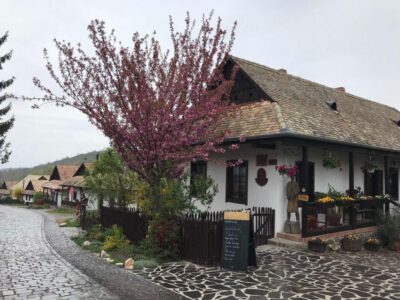
Budapest Walking Tours, compared.
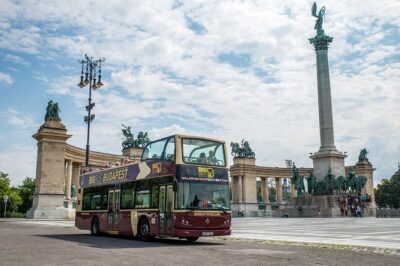 ★ 3.5Big Bus Budapest Hop-On Hop-Off Bus and Walking TourFrom $422,206 reviews
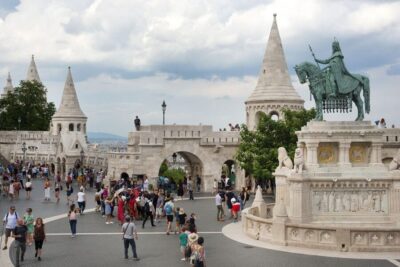 ★ 4.6Buda Castle District Walking TourFrom $142,108 reviews
 ★ 5.0Budapest City Landmarks Walking Tour in 2 HoursFrom $32,048 reviews
 ★ 4.83-Hour Orientation Walking Tour of Buda and PestFrom $411,834 reviews
 ★ 5.0Budapest Historical Sightseeing – Free Walking TourFrom $31,302 reviews
 ★ 5.0Budapest All in One Small Group Walking Tour with Strudel StopFrom $1001,277 reviews
 ★ 4.9Buda Castle District Walking Tour with a HistorianFrom $63867 reviews
 ★ 4.9BloodThirsty Hungary: Walking tour & Dark Historical StoriesFrom $21633 reviews
Browse the lists this tour appears in