
Tour review · BUDAPEST COMMUNIST HISTORY TOURS
Born Under The Red Star – The History of Communism in Hungary – Private Tour
Soviet power leaves physical clues. This private Budapest walk links major sites tied to the communist period, then slows down long enough for meaning, not just dates. You get hotel or apartment pickup and an easy private pace that fits your questions.
I especially like the way the route moves from symbols to testimony, starting with public memory and ending inside the House of Terror Museum. I also like the included break at a Communist-themed bar, where a retro soda makes the heavy history feel human and manageable.
One drawback to plan for: some sites are listed as free or partially covered, but entry details may vary by what ticket option you are getting, so ask your guide to confirm before you commit your time.
Key highlights to look forward to
- Private format with only your group, plus pickup at your address
- House of Terror Museum stop focused on fascist and communist-era oppression
- Szabadság tér for big memory collisions, Holocaust victims and Soviet liberation
- 1956 Hungarian Revolution memorial to connect the communist era to a turning point
- Retro soda and coffee or tea included, so you’re not just walking on empty
More of Budapest behind the Iron Curtain
- Budapest: Communist History Tour with House of Terror Option★ 4.8 · 182 reviews
- Communism in Hungary with a Historian★ 5.0 · 70 reviews
- Budapest: 3-Hour Walking Tour About Communism (Small Group)★ 4.7 · 70 reviews
- Lives of Hungarians Under Communist and Capitalist system★ 5.0 · 59 reviews
Why this private communist history tour works in real life

If you like history but you do not want a history lecture, this format makes sense. You walk with a guide through key locations connected to communist Hungary, and you get enough time at each stop to ask follow-ups and connect the dots.
The private setup changes the feel. When you are not sharing space with strangers, your guide can slow down when something is emotionally heavy or confusing. And because your guide meets you at your address, you are not spending your morning searching for a meeting point while your brain is still on vacation mode.
You should also know the subject matter is serious. The House of Terror Museum includes exhibits tied to fascist and communist regimes and it memorializes victims of detention, interrogation, torture, and killing. A good guide helps you keep perspective without turning it into doom scrolling.
Price and what you actually get for $108.14 per person
At $108.14 per person for about 3 hours, the value comes less from the walking and more from the guidance. This is not an app-based route. You are paying for a local person to interpret what you are seeing, and to keep the narrative coherent across monuments, memorials, and museums.
What is included is also practical. You get hotel or apartment pickup, maps plus further recommendations, and coffee or tea. The tour also includes a retro soda at a Communist-themed bar.
Important note for planning: the itinerary lists some admissions as free and others as not included, but there have been real confusion moments around what was actually covered for certain entrances. In other words, do not assume every site’s entry is fully packaged the way the wording sounds. It is worth asking your guide to confirm the entry for St. Stephen’s Basilica and the museum options on the day you go.
Stop 1: Soviet Heroic Memorial, learning how monuments sell a story
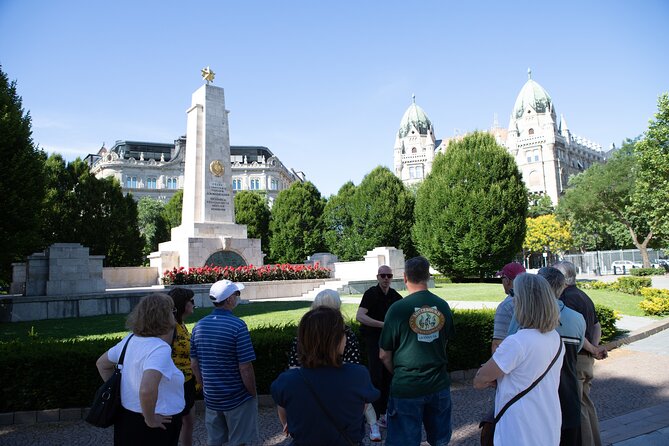
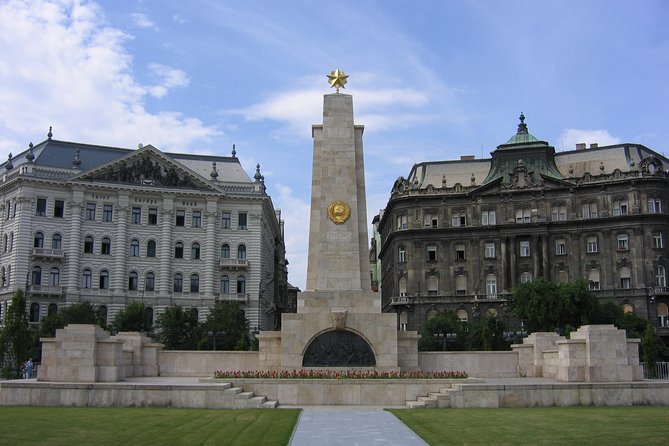
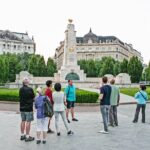
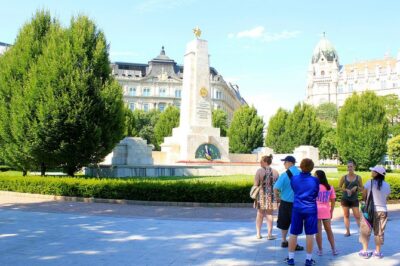
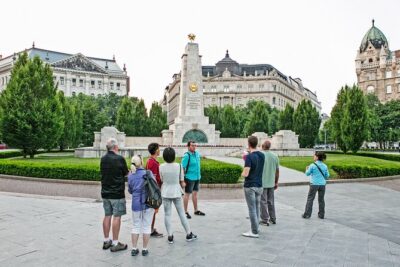
The tour starts at the Soviet Heroic Memorial, a white obelisk in a landscaped park that commemorates Russian military who served in World War II. Even before you get into communist-era details, this stop sets up the key theme: power loves public symbolism.
You will have about 15 minutes here, which is enough to look, listen, and understand why this kind of memorial mattered in the years after the war. The guide’s job is to explain what the monument represents officially, and what it meant in real political terms.
Quick practical tip: treat this as orientation. If you leave this stop with a sense of how regimes shape memory, the later stops will make more sense.
Stop 2: House of Terror Museum, where the communist era is not abstract
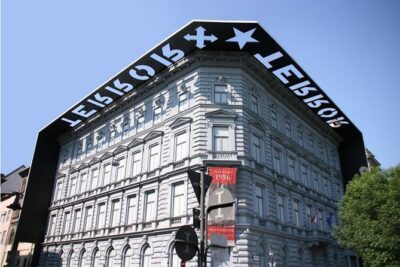
House of Terror Museum is located at Andrássy út 60 in Budapest. It is one of the most important stops on the route because it links political regimes to what happened to real people in the building.
You are given about 15 minutes for this stop, and the museum content covers exhibits related to fascist and communist regimes in 20th-century Hungary. It also serves as a memorial to victims detained, interrogated, tortured, or killed there.
This is the point where your guide’s tone matters. You want careful context, not shock for shock’s sake. A strong guide also helps you notice how propaganda and fear work, which you can then carry into the exterior memorial sites later.
Ticket detail matters here. The itinerary lists free admission for this stop, but there have been mismatches reported for what a free entry claim actually means in practice. Before you go in, ask your guide to confirm the exact coverage for the day’s ticketing.
Other Budapest days with the guide to yourself
- Budapest Essentials Private Tour Highlights and Hidden Gems
★ 5.0 · 861 reviews - Private Budapest City tour with Classic Russian Jeep or G-Wagon!
★ 5.0 · 386 reviews - Private city tour by van
★ 5.0 · 273 reviews - Budapest: Private City Tour with a Vintage Russian Jeep
★ 4.9 · 246 reviews - Budapest Private City Tour With a Vintage Russian Jeep
★ 5.0 · 198 reviews
Stop 3: St. Stephen’s Basilica, a counterpoint to state power
Next comes St. Stephen’s Basilica, known as Szent Istvan Bazilika. It is a Roman Catholic basilica named for Stephen, the first King of Hungary. His right hand is housed in a reliquary, and the basilica has long been a symbol of Hungarian religious identity.
You get about 15 minutes here, and admission is listed as not included. That does not mean the stop is useless. Even a quick look helps you feel the contrast between state ideology and older cultural institutions that outlast regimes.
There is also a timing reason this stop fits well on a history tour. You are transitioning from the museum’s direct documentation of state violence into public space memory at Szabadság tér. A church stop keeps you grounded in the everyday fabric of the country, not only the machinery of repression.
Stop 4: Szabadság tér and its two memorial narratives
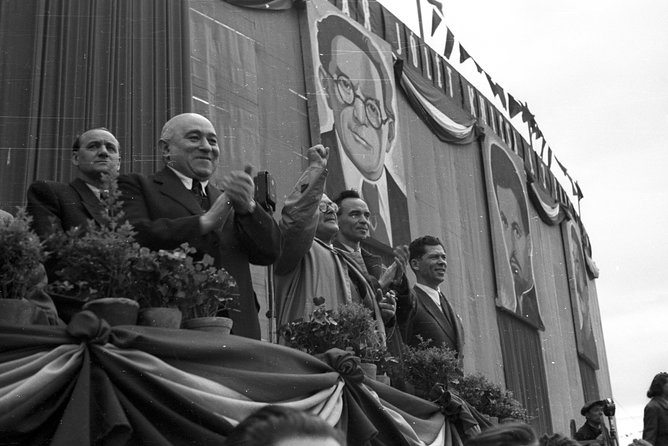
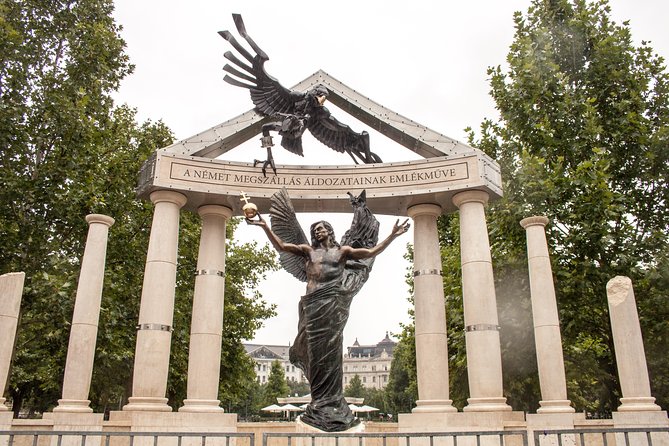
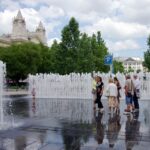
Szabadság tér, or Liberty Square, is in the Lipótváros neighborhood and it is famous for two controversial memorials. One commemorates Hungarian Jewish victims of the Holocaust. The other commemorates Soviet soldiers who liberated Budapest from the Nazis in 1945.
You will spend about 25 minutes here, and it is a strong pause in the itinerary because the square is built for conversation. You can look at the memorials, then look at the surroundings, including the United States Embassy and the historicist-style headquarters of the Hungarian National Bank on the west side.
This is also where you learn that memory can be political. The guide can connect how different tragedies were framed during different eras, including how regimes attempted to shape public interpretation of liberation and guilt.
Photo note: this is a great place for an establishing shot of the broader city context. If you keep your camera ready, you will get more out of the explanation.
Stop 5: Memorial to the 1956 Hungarian Revolution, the break in the script
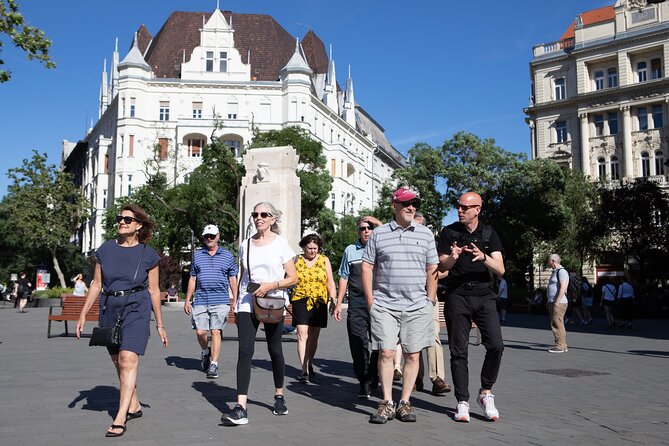
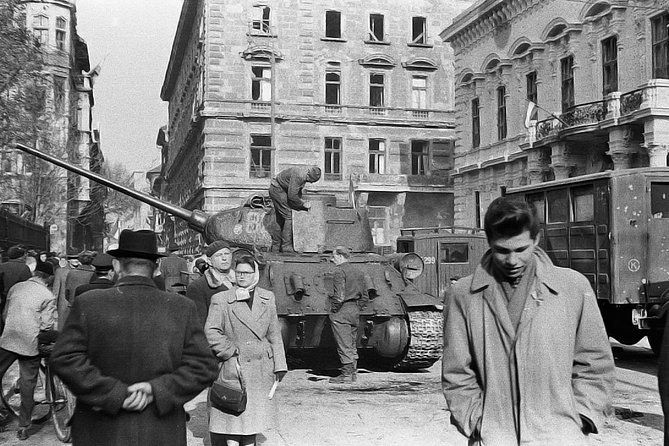
The 1956 Hungarian Revolution and War of Independence memorial is where the tour connects communist rule to a turning point. This memorial commemorates the heroes of the uprising against the communist regime.
You get about 15 minutes here, which is enough time to understand the stakes of 1956 without rushing. A good guide will frame 1956 as more than a date. It is a reminder that communism in Hungary was not just something imposed once. It faced resistance, negotiation, and consequences.
If you are trying to make sense of Hungary’s modern identity, this stop often helps. It bridges the narrative from Soviet-era symbolism and secret police-era fear into the moment Hungarians demanded change.
Stop 6: Hungarian Parliament Building, seeing power in architecture
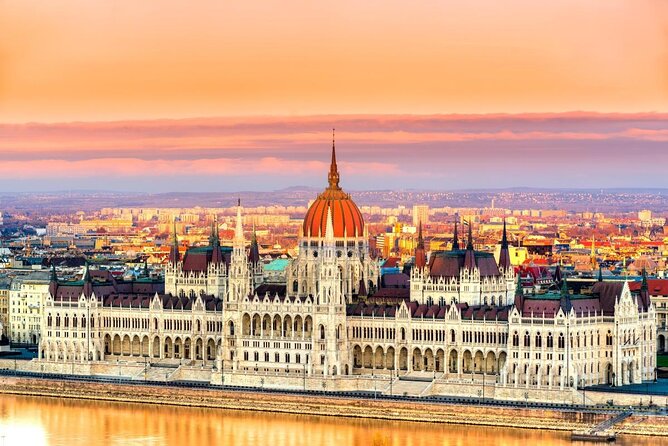
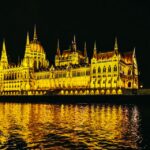
The final named stop is the Hungarian Parliament Building, also known as Országház. It is the seat of the National Assembly of Hungary and it is a landmark and popular tourist destination.
Expect about 15 minutes at this stop, with admission listed as not included. Even without going inside, this exterior moment works because it shows you how state authority looks when it is institutional, formal, and long-lasting.
This is a helpful finish for your walk. You began with a WWII commemoration, moved through a museum tied to coercion, then shifted into religion and public memorials, and now you land at the seat of national government. It gives you a clearer overall picture of how regimes and nations leave traces.
The Communist-themed bar stop and your retro soda reset
One of the most “you can actually do this on vacation” parts of the tour is the included drink stop. You visit a Communist-themed bar for a retro soda, plus coffee or tea is included.
That matters because this tour covers heavy content. A short pause with a guide is not just a treat. It helps you absorb what you heard and asks questions while the ideas are still fresh.
From what guides do in this format, you might also get practical context about how people talk about the past today, including what still feels sensitive. It keeps the history from becoming a sealed box.
Timing, pace, and how to get the most from 3 hours
This is about 3 hours approx., and each stop is scheduled in short bursts, roughly 15 minutes each, with a longer 25-minute block at Szabadság tér. The pacing is intentional: it prevents information overload while still keeping you on track.
Because it is private, you have a real advantage. If something hits you emotionally at the museum, your guide can slow down. If you want more detail at a memorial, your guide can shape the conversation.
Bring a modest plan for energy. You are near public transportation, and the tour asks for moderate physical fitness. That usually means you can comfortably walk city sidewalks and step in and out of spaces without needing special mobility support, but you should not expect an all-chair experience.
Tickets and free-entry wording, the part you should confirm
The tour’s itinerary lists free admission for the Soviet Heroic Memorial, the House of Terror Museum, Szabadság tér, and the 1956 memorial. It lists admission as not included for St. Stephen’s Basilica and the Parliament Building.
However, there have been real-world issues around how “free admission” is interpreted at the basilica and the museum. To protect your time and budget, do this: when your guide meets you, ask what you are covered for at each pay-to-enter site.
Also, if you specifically want to visit domes or special sections, do not assume it is covered by a general free entry label. Plan a small buffer just in case you need an add-on ticket.
Which guides make the experience click
The tour can hinge on your guide, and names matter here because they hint at the style you might get. Guides such as Julia and Brigit have been praised for detail and for connecting personal perspective to the hard subject matter. Other guides like Norbert have also been noted for flexibility and friendliness, which helps when you are navigating a tight schedule.
Even when the content is difficult, the goal is to make it understandable and human. If your guide seems willing to adapt, you usually get a better balance between facts, context, and the emotional weight of the topic.
Who should book this Budapest communist history tour
Book it if you want a focused route through the communist era that is not just museum time. You get a mix of monuments, memorials, and a museum, so your understanding forms in layers.
It is also a good fit if you like walking with a guide who can explain why a single square or obelisk can carry political meaning. The connection between WWII memory, communist rule, and later resistance is the heart of the experience.
Skip it if you want something light, entertainment-first, or purely panoramic. This tour deals with oppression and victims, and it expects a respectful, serious mood.
Should you book Born Under The Red Star in Budapest?
If you want a private, guided timeline of Hungary’s communist past that moves beyond classroom facts, I think it is a smart pick. The route is compact, the included stops (especially the retro soda break) make it practical, and the narrative connects public memory with documented suffering.
Just treat ticket wording as something to confirm, not a guarantee. If you ask your guide what is included at the museum and at St. Stephen’s Basilica, you will protect yourself from surprise costs and keep the day flowing.
FAQ
How long is the Born Under The Red Star private tour?
It runs for about 3 hours.
Is pickup included?
Yes. Hotel or apartment pickup is included, and your guide meets you at your requested address.
Is this tour private?
Yes. It is a private tour or activity, so only your group participates.
What language is the tour offered in?
It is offered in English.
Are admission tickets included for all stops?
The itinerary lists free admission for the Soviet Heroic Memorial, the House of Terror Museum, Szabadság tér, and the 1956 memorial. Admission for St. Stephen’s Basilica and the Hungarian Parliament Building is listed as not included.
Can I cancel for a full refund?
Yes, you can cancel for a full refund if you cancel up to 24 hours in advance. Free cancellation is available, and weather cancellations can also lead to a different date or a full refund.
More Private Days in Budapest




More Communist-Era Budapest



More Tour Reviews in Budapest




Recently added around Budapest


Budapest Communist History Tours, compared.
 ★ 4.8Communist History Tour with House of Terror OptionFrom $58182 reviews
 ★ 5.0Communism in Hungary with a HistorianFrom $5970 reviews
 ★ 4.73-Hour Walking Tour About Communism (Small Group)From $5770 reviews
 ★ 4.5Budapest Hammer & Sickle Communist Times TourFrom $7968 reviews
 ★ 5.0Lives of Hungarians Under Communist and Capitalist systemFrom $459 reviews
 ★ 4.5Private Budapest Hammer & Sickle Communist Times TourFrom $13347 reviews
 ★ 5.0Communist Budapest Walking TourFrom $12624 reviews
 ★ 4.9Memento Park and Icons of Communism Guided TourFrom $6323 reviews
Browse the lists this tour appears in